Do you constantly put everyone else's needs ahead of your own?
If so, you're not alone. This week, we're focusing on one way to mitigate the 5 core symptoms of underearning: learning how to say "no" with class and authenticity. This is the third in a series of videos this summer about overcoming the cycle of underearning.
As a mom and recovering pleaser, I have struggled with this issue personally for YEARS. This week's episode shares some examples and word choices you can swipe to help you practice saying "no" with class and confidence before the moment strikes. I also share an important warning about the tricky way your "no" can turn into an unwanted "yes" or a straight-up lie if you're not careful.
How do you handle saying "no" and setting healthy boundaries?
Share your thoughts and ideas in the comments. Your insights may spark a conversation that helps someone else!
If you haven't already accessed this week's bonus content, you'll want to do that here. Not a member yet? It's free! When you register for email updates, you also get access to episode transcripts, worksheets, and other downloadables!
Credits and Sponsors
Fashion jewelry from Kerianne at FancyBargain.com. Tell her you saw her bling on Creative Freedom!
This is Season Four, Episode Four. Where we talk about how to say "no" with class and authenticity. Got someone who wants to pick your brain, ask you for a discount, or - GASP! - work for exposure? Need a classy way to say "um, no thanks!" without burning bridges or sounding like a jerk? You need this episode!
Being a doormat in your business sucks, quite frankly. It's also potentially a sign of co-dependence, which is one of our 5 Symptoms of Underearning. If you're saying yes to everyone and everything except yourself, it's time to re-wire your brain. Saying "no" is sexy, y'all, and today, I'm sharing tips to help you say it with class & authenticity. This is the third episode in a Summer-long series that deals with different aspects and triggers for underearning.
Need help with that whole "re-wiring" thang? Look no further than Overcoming Underearning for Creative Entrepreneurs. In just 5-weeks, you could build the clarity, confidence, and courage you need to finally beat the cycle of underearning once and for all. Plus, you get individualized email support throughout the program, so you're never alone in this journey.
If you’re listening to just the podcast, you’re only getting about a third of the deal. Catch the Creative Freedom web series or join me on Facebook on Fridays at 5:30pm Central time for a LIVE Q&A about the week's topic.
Show Notes
3:08 - The alternative to the vicious cycle of deadbeat clients and doing work you hate.
04:32 - The "Beef Stew" problem that shows up when you don't stand your ground and say "no".
9:00 - The importance of honoring boundaries
12:06 - What to say when someone is trying to talk you down on your rates
16:00 - The importance of saying "no" and trusting others to do their own work.
19:16 - The greatest lesson my Mom ever taught me.
24:03 - What happens when the desire to "not lose" ruins your plan to succeed (and how to fix it)
Once upon a time, I ran ten miles and no one was chasing me.
It was a bucket list thing, to run the Bobby Crim 10-mile road race in my hometown. So I suited up and, in a matter of just over 2.5 hours, managed to lose about 4 pounds. Ha.
I also learned a lot about how to manage yourself as you combat overwhelm. Because, believe me, I wanted to quit MANY times. I have never been a professional runner. I barely trained for that race. But I finished. And the lessons I learned running that race can help YOU defeat overwhelm and keep momentum going when things get hard.
If you haven't already downloaded this week's bonus content, you'll want to do that here. Not a member yet? It's free! When you register for email updates, you also get access to episode transcripts, worksheets, and other downloadables!
This is Season Four, Episode Three. The overwhelm episode. Overwhelm is a common trap for creative entrepreneurs caught in an underearning cycle. What can you do when you're knee deep in a project (or multiple projects) and have to keep going? Lisa shares what she learned running her first (and only) 10-mile foot race about how to keep momentum when you get overwhelmed.
This is the second episode in a Summer-long series that deals with different aspects and triggers for underearning. If you want to take this learning deeper, consider joining Overcoming Underearning for Creative Entrepreneurs.
If you’re listening to just the podcast, you’re only getting about a third of the deal. Catch the Creative Freedom web series or join me on Facebook on Fridays at 5:30pm Central time for a LIVE Q&A about the week's topic.
Show Notes
01:06 - How running The Crim (as an overweight 26-year old) gave me a new perspective on dealing with overwhelm.
03:38 - The importance of a finish line in a race (and your work).
07:12 - The "Heartbreak Hill" of overwhelm, and how to get from the start to the finish through even the toughest part of your "race" - even if it's not sexy.
12:15 - Why running together is a different race than running alone, and how that impacts the way you deal with overwhelm.
17:11 - The reasons the 3 creative types can't give up control or accept help - and how to see things differently.
20:14 - The art of delegation - it may not be what you think it is.
It's been a busy month at Creative Freedom HQ! As the first quarter of the year heads into the sunset, I've been plastering my face and voice all over everyone else's website this month in preparation next month's big open enrollment for the Creative Freedom Incubator. If you know you need both coaching and hands-on help in your business, think about applying now to beat the rush. For a limited time, I'm waiving the application fee, so don't dilly dally!
I had the joy of being featured in 4 different places this month. Please check 'em out, leave a comment, and let the hosts know that you'd like them to bring me back! It's your comments, feedback, and recommendations that help me spread the Creative Freedom message far and wide!
Profit. Power. Pursuit. podcast
Host Tara Gentile and I sat down to talk in-depth about the Creative Freedom Incubator - what it is, how it works, and more importantly, WHY it works. Designed for creatives in Early Struggle, the Incubator combines coaching with crucial hands-on business support (VA/Marketing/Admin) that most early-stage businesses need, but can't afford.
We go behind the scenes in how the whole concept was developed, how it evolved, the tough lessons I learned in the first year, and how I've adapted the program to better fit (and inform) my business model. I also talk about what didn't work, client results, and how I've set things up for more success (for them and myself) going forward.
This is my second appearance on Mike Michalowicz's popular show. He's a funny guy, and his co-hosts keep things hopping. Mike's the guy who wrote The Toilet Paper Entrepreneur, The Pumpkin Plan, Surge, and, yes, Profit First. His new book, Clockwork will be out this fall.
This was my first (and hopefully NOT last) appearance on The Strategy Hour with Abagail and Emylee. These two are a powerhouse combination of business smarts and compassion for the creative entrepreneur's lifestyle. We talk about the importance of striving for a six-figure business - or not, and the rare reasons why you may not need to aim that high. We also dig into the Cusp types - something I don't get to do very often when talking about the Creative Entrepreneur Type Spectrum. If you're a cuspy, this could be some great learning for you.
I love me some Charlie Gilkey! I was lucky enough to be a guest just as the Creative Freedom Spectrum was coming into the world, so when they asked me back as a contributor, I was thrilled!
On the heels of Oprah's Golden Globes speech, this post provides some insights for people wanting to speak their truth with their audience in ways that won't alienate their true fans, while still being a genuine reflection of their thoughts, values, and beliefs.
Yep, it's been a pretty busy month for me, and I wouldn't trade it for the world. But we've also got some big happenings coming up around here, too. The new season of Creative Freedom is right around the corner, and I can't wait to share the new episodes with you!
Again, Please take a moment to check out the content that interested you, leave a comment or review, and let the hosts know that you'd like them to bring me back! Your comments, feedback, and recommendations are an important part of making sure I get to be a repeat guest. And if you know some podcast or stage I should be speaking on, let us know! I'd really like to see more people this year and get Creative Freedom into as many hands as possible!
[Note: This is another excerpt from my forthcoming book "Creative Freedom" - which I'll be sharing in full with participants at Creative Freedom Live. Seats are going fast - we've got about 5 spots left. If you want one, it's time to get moving and get registered!]
In all my years as both a creative entrepreneur and a coach for other creatives, I've watched plenty of people rise and fall. From one-hit wonders to big-shot internet marketers, some have staying power while others go stale faster than an open bag of potato chips in Michigan's muggy Summer weather (trust me, it's bad!).
What is it that causes some creatives to rise to prominence while others remain in obscurity?
It's something that's fascinated me for years. We all know someone that we think doesn't deserve the spotlight they have. You may be more talented than they are, and yet they're the ones with all the attention. Sometimes they're slimy jerks, who've manipulated their way to the top, and other times, they're just "in the right place at the right time" because they've got connections you don't. And then there are the truly amazing superstars that give us hope, inspire us to go after our dreams, and become our role models on our creative journey - the ones who we believe deserve all the kudos and accolades they receive.
Regardless of HOW they rose to prominence in their field, they've worked hard to get there - even if the work was less than ethical.
But there's something I've found that all these people have in common - whether they're good-hearted, wonderful people or slimy, manipulative baddies. In fact, there are 4 must-have skills and traits that every single one of them have in common - regardless of their creative type. Without them, it becomes nearly impossible to achieve the success and longevity you desire as a creative entrepreneur.
4 Strengths Every Creative Entrepreneur Needs To Succeed
Clarity
This one seems obvious, right? But clarity is very nuanced. What exactly do you need to be clear about?
For one thing, a creative entrepreneur need to be clear on who they are. My friend, Tajci Cameron was an international pop music superstar and she bagged it all because they were trying to cram her spirit into a mold that didn't fit the powerful, thoughtful, change-making woman she was becoming. She came to the states with just a few dollars, knowing no one. Decades later, Tajci's created her own path - one that's given her more joy and fulfillment than she ever had in her "glory days" when they made a doll in her image.
Tajci has one of those dolls on a shelf in her office. I was envious when I first saw that doll. But then it occurred to me that the doll represented just one small piece of who Tajci really is. She's so much more than a doll in a box. No box could ever contain the boundless light, life, and joy she brings to her fans (and the world) through her music, stories, and video journal. Tajci's found a way to stay true to who she is and still create in ways that are meaningful to her.
In addition to being clear on who you are, you need to be clear on how you want to show up in the world. You also need to be clear on your message and why it matters to your audience. These answers come with time and practice, but they are crucial to having staying power as a creative entrepreneur. Tajci could have given up years ago, but she knew that music was her path.
"Throughout my journey," she says, "knowing there was someone out there who could hear my voice and my songs gave me a sense of being heard, accepted, understood and loved... I am a singer/songwriter and passionate about my music, I use it to express myself and give voice to my soul- as free as I am courageous to let it be."
Courage
It takes guts to face regular rejection of your work - and not see it as a personal rejection. It takes guts to step out on faith and do something you've never done before. Yet courage is one of the biggest elements sorely lacking in so many talented creatives. When I was a kid, I was told to be offended if someone ever said I had potential. "It means you're not living up to it."
"Usher happened to roll up in his Range Rover. I ran up to him, and I was like, 'Usher, I love your songs. Want me to sing you one?' The politest possible way he could say no, he did. ... I took the hint. I didn't get to sing for him: He had to run into a studio session."
Kids are often the most courageous among us, and Bieber was still a kid at the time of this chance meeting with his idol. He didn't let that stop him. He knew this might be the only chance he had to meet or talk to Usher, and he took that chance. It didn't seem to pan out at first, which is more common than you might think. But thanks to a little help from his support team (we all need one), Justin did get that chance after all:
"He actually watched my videos — after my manager got to talking to him — and was like, 'I should have let this kid sing,' and flew me back to Atlanta where I got to sing for him in a proper setting."
You've got to have the courage to own your message and speak it into the world - in whatever format your Great Work "speaks". You've got to have courage to consistently show up as your true self - warts, sparkles and all, as I like to say. You've got to be willing to be unpopular, and sometimes borrow someone else's courage for yourself. Stephen King's book Carrie was rejected so many times he threw it in the trash. But his wife was courageous enough to dig it out of the trash and not let him give up.
You've also got to be courageous enough to admit and own your mistakes and make amends.
Confidence
Courage creates opportunities for practice - which is how you build confidence. Confidence to nurture your message, nurture your audience, and nurture yourself. It's the difference between being a Freshman and a Senior in high school. My physics class had students from all grades in it. Sure, I was smarter than some of the Seniors in that class, but when we left the classroom, they were the ones exuding more confidence in the halls. They knew who the best teachers were, which ones to avoid, and the underclassmen looked up to them, aspiring to be them in many cases.
When you've been at the game for a while, you know the rules, you know where you can bend them and where you have to press on through the hard stuff. You know what to avoid, what to accept, and what you can change. You know the difference you can make. That's the difference between courage and confidence. Courage comes from facing the unknown while confidence is built through knowing.
Confidence allows you to say no with grace and yes with enthusiasm and know when things are or are not a good fit for you. Confidence gives you a greater ability to trust the process, trust your team, and make strategic decisions that benefit you in the long term even if they're not so great for you in the short term. Many times, when working with clients, this is the piece that snaps together the fastest, once we've got their courage issues handled.
Confidence is NOT the same as arrogance. Arrogance is confidence in your own infallibility. No one is perfect. Arrogance drinking your own Kool-Aid and believing your own hype. Don't fall victim to it.
Cash Flow
Here's the kicker. Ya gotta have more money coming in than going out. Toni Braxton is the poster child of this issue. After filing bankruptcy, she worked her way back and launched a self-funded stint in Vegas. Just after she renewed her contracts, she was diagnosed with medical conditions that kept her from keeping her commitments. She filed bankruptcy again, this time knowing she never be able to perform at her peak again. "I'm definitely on a budget," she said in a 2012 interview.
Where's the money coming from? Where's it going to? What do you have set aside or saved up for the unexpected? You can run on credit for a while, but, like Braxton, it'll eventually come back to bite you. The sooner you can get in the black and stay there, the better off you'll be.
I talked about all this in today's Facebook Live. Here's the replay:
[Note: This is an excerpt from my book, Creative Freedom: How To Own Your Dreams Without Selling Your Soul, that's coming out later this year. If you haven't already, take the quiz to determine your creative type. Be sure to get on the notification list to stay up to date on the book's release date!]
One of the conversations I have pretty regularly with people is around what it means to be a creative entrepreneur. Contrary to what you might think, it has nothing to do with what or how you create. Everyone is creative in some way. EVERYONE. The indicator, then is whether or not you choose to be an entrepreneur around your Great Work.
All entrepreneurs are creative, but not all creatives are entrepreneurs.
Not all creatives are entrepreneurs, and that’s okay. Elizabeth Gilbert wasn’t a creative entrepreneur when she wrote “Eat, Pray, Love” and her work impacted millions around the world. She also made some pretty good money, I’d be willing to bet, or she’d never have quit her day job. But you don't have to make good money to be a creative entrepreneur - in fact, you might not make any money when you start.
So how do you know for sure? Here are five signs that you’re not a creative entrepreneur:
You don’t want to make a living at it.
For the purposes of this book, if you create as a hobbyist, or for side income and don’t ever plan to make it your primary source of income, you’re not a creative entrepreneur. It doesn’t matter if your Great Work is sculpture, business analysis, architecture, or video game walk-throughs on YouTube. The type of creativity you express has nothing to do with whether or not you’re a creative entrepreneur. It’s your intention around that creation that matters.
As a creative, you can create for yourself and not care what anyone else thinks about your work. As a creative entrepreneur, you have to listen to your audience and respond to their changing needs. That doesn’t mean you can’t create for yourself and your own enjoyment, but it does mean you have to have clarity around what elements of your Great Work will respond to the fluctuations of the market. Jim Henson did a lot of commercial work to have the money he needed to be able to make movies like Labyrinth and The Dark Crystal. He had his own “shrine to the almighty dollar” as a reminder that you can’t make art unless you have the money to do so. Money is freedom for a creative. It gives you the ability to do what you want without having to bear the criticism of others.
You don’t treat it like a real business.
Are you creating for a specific audience? Did you establish a legal structure for your business? Are you reporting income and paying taxes? Are you actively marketing your Great Work in the world? If so, then you’re probably a creative entrepreneur, even if you’re just getting started in “jobby” mode (a hobby disguised as a business). If your aim is to make this a going concern, and you’re focused on growing your company as a business owner, you’re most likely a creative entrepreneur. You might not have a profitable business yet, but you’ve got the creative entrepreneur spirit that is needed to grow.
You don’t “do marketing” for your Great Work.
Thomas Edison devoted himself entirely to business. According to author and archivist, Leonard DeGraaf, Edison “vowed he would not invent a technology that didn’t have an apparent market; that he wasn’t just going to invent things for the sake of inventing them but… to be able to sell them.”
Edison himself is quoted as saying “All my life, I’ve been a commercial inventor. I have never dabbled in anything that was not useful.”
Edison was very clearly a creative entrepreneur. If you are actively trying to serve a particular market, sharing your gifts with them, and making sales offers to them, you are also a creative entrepreneur.
You don’t even look at the numbers.
Income and expenses. Cash flow. Profit. Do you have your finger on the pulse of what your business is actually doing? Chaotics struggle with this sometimes, because they have an aversion to numbers and structures in general.
In her autobiography, Put On Your Crown, Queen Latifah tells how, due to a clerical error that went unchecked, all her money was out of whack. She was scrambling to pay bills not because anyone was intentionally trying to screw her, but because she stuck her head in the sand and didn’t pay any attention to the numbers.
Latifah then revealed a secret she learned from an episode of Oprah: “always sign the checks.” This was a simple way for her to keep a finger on the pulse of her business.
By reviewing your numbers consistently - even if they’re not where you want them to be - you keep yourself in the know. And knowledge is power.
You can’t or don’t trust others to help you grow.
This is another sign of creating a jobby for yourself, by the way. Each of the type can suffer from this issue for different reasons. Chaotics don’t trust that other people will rise to their (impossibly) high standards. Fusions are so used to doing everything themselves that it feels painful to slow down long enough to get or train help. Linears will micromanage deadlines and budgets, which tends to drive people away.
At some point, if you’re growing a business, you’ll have to ask for and accept help from others who may not do things exactly the way you would. Like when I ask my son to clean his room, it may not be clean the way I would do it, but it meets my criteria for a clean room. If I don’t want to be stuck doing all the cleaning, I have to be willing to let go of the trivial things - like how he folds his socks. So long as the clean clothes fit in the dresser, I’m happy.
That doesn’t mean compromising on what really matters, but chances are good you’re worrying about more than you need to at this early stage in your business growth. Nobody expects a young business to deliver at the same level as a fortune 500 company. Use that to your advantage to surprise and delight your audience - but don’t let it keep you from delivering at all because you’re too mired in doing ALL THE THINGS!
To be clear, EVERYONE is creative in some way. It could be the way you solve a problem or spot patterns, it could be the way you dress up a gift bag with ribbons or paint. The fact that you use your imagination to see or bring something to life that wasn’t there before makes you a creator and therefore a creative.
Entrepreneurs are especially adept at seeing a need and creating something to fill it, but not all creatives are entrepreneurs. The dictionary definition of “entrepreneur” is someone who takes on a “greater than normal financial risk” to organize or operate a business.
Many creatives I know don’t want more risk, they want stability. They’re freaked out by the notion of the starving artist. Like Gilbert, they’re content to rely on their day job and dabble in their creative work during their hobby time. If that’s you, then you don’t need this book.
On the other hand, if you’re ready to make a transition plan from the day job, if you’re already knee-deep in your creative work and need some clarity and direction to make it a profitable and sustainable business, then you’re in the right place.
I developed the Creative Freedom Entrepreneur Type Spectrum to give creative entrepreneurs the clarity they need about how to best set up and run their business - in a way that works with their unique quirks and traits. You’ll get clear on how to use the ninja skills of your specific type to make your business more productive and profitable, and how to clear up your blind spots so you don’t end up stuck like I was, doing things that will only make you miserable.
Does it take longer or more effort to build a business doing something you love? That depends on you. But my experience and that of my clients shows that it’s worth it. You’re building a long-term asset instead of looking for short-term “low-hanging fruit”. And it’s often easier because your efforts are bolstered by the fact that you’re doing something you love, instead of something you dread.
Here's the replay from my Facebook Live on the topic:
So there's this show on Netflix that my youngest son has taken to this summer.
Canada's Worst Driver. Well, after several seasons, they decided to round up the worst of the worst for a final season:
Canada's Worst Driver Ever.
I won't spoil it for you, but these drivers are absolutely frightening, sad, and hilarious. What really struck me was how some of the simplest instructions were completely lost on these folks.
Then it hit me that creative entrepreneurs have similar issues in their business.
So I'm doing a a Creative Freedom live episode on my Facebook Page, to share the 3 biggest lessons from Canada's Worst Driver Ever that apply to creative entrepreneurs. Here's the replay:
This week I had an AMAZING photo shoot that's been several months in the making. I knew when I landed in Nashville, starting over would take up a good portion of my first year here. I also knew that I had projects that still needed to move forward: I've been sitting on Creative Freedom for a while now, and The Damn Whippersnappers have promised to visit this summer for a recording session. So with a new book and new music in the works, of COURSE I needed to get the website redone.
A perfect storm for new pictures!
Only, I didn't know anyone in this town, so I had no idea how long I'd have to wait, how much it would cost, or anything. Luckily, my best friend, Google helped me out. I met Emily, a wardrobe stylist from Effortlesstyle here in Nashville. She came over, looked at my closet and said "let's just start from scratch, okay?"
hee. hee.
While I know how to clean up, I've never been at the bleeding edge of style, and I told her that. My closet is full of black, black, and more black - with a splash of solid color here and there. So I gave her a budget and she went to work. A week or so later, we met for the fitting. There was really only one piece I couldn't bring myself to like. Everything else was wonderful - and a lot of it I wouldn't have picked for myself. Like this floral top. When I first looked at it, all the voices in my head took a swing at me:
"Oh, you're too big to wear white!"
"That floral print is just going to draw all kinds of attention that you don't want."
I swallowed hard when she showed it too me. I knew Emily could sense my reluctance. "Just try it on." she politely insisted.
I did. We found a keeper.
I had just raised my threshold of belief around what was possible for my wardrobe. Emily's a professional that's been doing this for years. Despite that, it was hard to trust her at first because I didn't know her. I didn't believe she could style a plus-sized momma like me.
Luckily, she made it easy to like her, and her ensemble choices were on point, so trust came quickly.
Which was good, because the hair and makeup artist I had originally asked to do the shoot booked herself another appointment and was unable to make our shoot date. It wasn't her fault. I was trying to coordinate all the details myself, and things didn't come together. Frantic, I asked Emily if she had any suggestions.
"Oh, yes!" she said. "I've got my GIRLS!"
Panic turned to relief, but I had no idea how much I'd be paying for TWO people instead of one.
I swallowed hard again, and just trusted the process.
I arrive at Emily's house on the day of the shoot for hair and makeup. Mind you, two total strangers are about to have their way with my head. The ONLY thing keeping me from not showing up is the commitment I made to my photographer, Ashley.
That, and I trusted Emily. She hadn't steered me wrong yet, so I figured she wasn't going to start now.
I knock on the door, walk in, and I'm greeted by two of the sunniest, most enthusiastic women I've ever met. Both hard-working artists, both incredibly talented. Both eager to make magic happen.
Why did I ever doubt Emily?
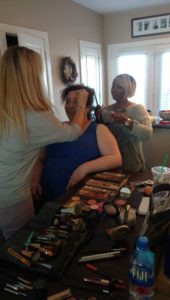
Within minutes they are both working on me: Angela at the front, Genia at the back. We're chatting, really connecting, and they're making it easy for me to trust them. But...
I don't even know how much time has gone by, I can't see a mirror, and I'm still too nervous to eat any of the snacks Emily's put out for us. I did manage to down a glass of water, because I kept telling myself "it's gonna be hot outside, you don't want to die of heat stroke!"
Still, I think I managed to keep my self-doubt to myself as we talked about building a business doing what you love, something I'm pretty passionate about. My fear was, hopefully, masked by my enthusiasm for profitable creative businesses.
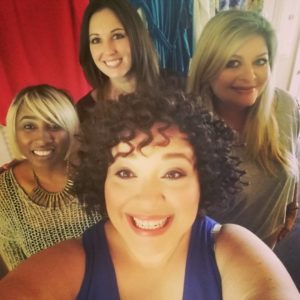
When they finished, I snapped a quick photo of my glam team and off we went to meet Ashley at Cumberland Park. When I got in my car, I had all I could do to keep from crying. I looked GOOD! Like, I almost didn't recognize myself. I had a vision of what I wanted for the shoot, and even hired Duane "The Hair Fairy" Edlao to cut my hair before I met these ladies to make sure that it would do what we wanted it to do. But to see it actually come to life?
Whoa.
We headed off toward Nissan Stadium to meet Ashley for the shoot. This is the first time we've met in person, and she looks happy, so I'm feeling more relaxed at this point. She's got some ideas about how to get in all the wardrobe changes and make the most of our time together.
The first few pictures felt awkward to me - because my inner critic was having her way.
"Who do you think you are? You're no super model."
There was a couple sitting at a picnic table across the way. They both stopped and looked up as my entourage pulled up with all our gear. I joked about being famous, but inside I was a self-conscious mess.
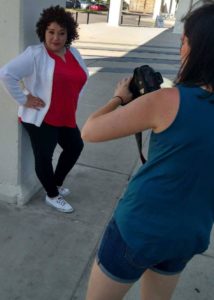
Despite these women all being super talented professionals, my inner critic was having her way with me. I told Ashley to "just shoot everything" because I knew that candid moments would probably end up making the most "natural" shots, plus we'd get some behind-the-scenes shots, too, which would be great for me to share with my clients in A-club. In truth, I was just hoping that, if she shot everything, there might be something that I could use.
Good thing Emily was listening, because she took some great candids, too. Like the shot of Angela, above, touching up my face, or this one, which is quickly becoming one of my favorites.
When I saw the first photo, I knew I was in good hands and I could relax. That's when we had REAL fun!
We joked, got silly, and just enjoyed being together - creatives whose only agenda was to create. Make magic happen. That was all we had to do, and when we could really let loose and trust each other, poof! The magic was there naturally.
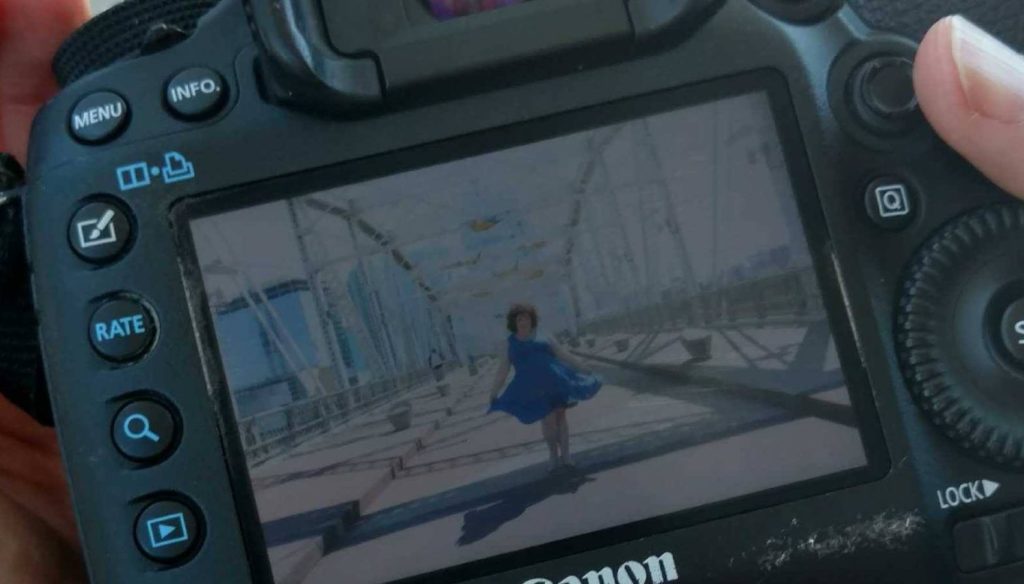
The rest of the hour-long shoot went by fast, and it really felt like we were a team - working together to tell a compelling visual story. I look forward to seeing the proofs that Ashley took. Here's a sneak peek from the back of Ashley's camera...
This photo shoot was a massive investment in the future of my company, and it would be easy to just stop there...
...But that would be the least important part of the story.
MOST importantly, this was an investment in ME.
As the pictures started appearing, people on Facebook started asking me what the shoot was for. It was easy to say "new book, new album, new website," but that wasn't entirely true. It was also a "new me" of sorts.
In the past, I would have tried to DIY as much as possible and keep everything on the cheap - not to be efficient or save money (though those are the excuses I would have used), but because of my own self-worth.
I put at least ten times the money into this shoot than any other shoot I've ever done. I'm not saying that to brag. I still feel strange about it, to be honest. I tell you this because there was a time in my life where I didn't believe I was WORTHY of investing "that kind of money" in me or my dreams.
Some days, I still struggle with my worthiness.
My early photo shoots were courtesy of my kid, or good friends who were skilled with a camera. I actually hired a photographer and hair/makeup artist for my last shoot because I wanted to get some specific shots for the album. I was leery then about spending "that kind of money" on a project that had no guarantee of completion, let alone success. But I was so happy with the results that I used those pictures all over the interwebs for a couple of years.
This time, I had a team of three incredible women who had my back the entire time (four, counting my photographer!). They probably had no idea of the "who do you think you are?" trash talk my inner critic was laying on me. At least, I hope they didn't. I am thrilled that they made it SO easy for me to just be ME in front of the camera.
But what's that got to do with pricing? Plenty.
The next day, I was talking with one of my coaches about my book, online course, and live event all built around the foundation of Creative Freedom. One of the last things she said to me was about the pricing for my upcoming event. I've been in a holding pattern for WEEEEEEKS because I haven't been able to decide how to price it or how and when to offer the online version. I told her I feel confident that I could easily charge twice the price because I believe it'll bring a solid 5-10x return on investment, but I was keeping the intro rate low because I wanted to fill the program (totally an ego thing, by the way).
When she looked at my pricing and asked about my motivations, she reminded me that sometimes, when we offer discounts and low-ball our pricing, it doesn't actually empower our clients, because we're modeling a behavior that comes from a place of scarcity instead of abundance. She then asked me "what if, by lowering your prices, you're denying your clients from having the same experience you just had at your photo shoot?"
Eyes Opened.
If you've got a healthy relationship with money, this probably doesn't apply to you, but if you struggle with naming a price that feels right to you because your inner critic is asking "who will pay that?" - this could be helpful.
The answer to the "who will pay that?" question isn't found in the circle of people you've been begging to buy from you. The answer is found in the faces of the people who light up when you enter the room and say "where have you been all my life!?!?"
Sadly, most of us build our careers around the former and not the latter.
This is one of the reasons I encourage my clients to develop a $25,000 offer... not because anyone will ever buy it (though it does happen), but because it gets you thinking differently, so that when you offer something for $2k or $5k, you'll feel more confident around the real value you bring to your work.
What could happen (for you and your potential clients) if you just created and asked for the price you want without all the baggage attached?
Because it doesn't matter what price you pick, there will always be someone that can't or won't pay it. But there are also probably a few people who will.
Owning your dreams, without selling your soul. Finding yourself and building a life and business that works for who you really are and what really matters to you. Making good money doing what you LOVE (and all the ladies from my shoot love what they do). THAT is what Creative Freedom is about, and I can't wait to share more of this new evolution with you.
Oh, and tickets for the virtual workshop and online event will be on sale soon. If you're not already on my list, get there to be one of the first to know about it!
No sooner had I finished my lunch when the phone rang. It was my oldest.
"Hey, are you okay?"
"Not really, Mom. Aunt Dian died."
Less than an hour later, I was on the road to Michigan. 9 hours later, I'm crashing at my ex-husband's house for the night. That meant I wasn't able to have any studio recording time this week to film new episodes of Creative Freedom for you.
And that turned out to be an important business lesson I didn't want you to miss.
Life Happens: How do you handle it?
People are born. People die. Stuff happens in "the in between years." You leave a thumbprint on the lives of many people in those years.
As a creative entrepreneur, our work is often an extension of who we are. It's not like you can put it on the shelf at 5pm and call it a day. It follows you everywhere, like a toddler who just wants more Mommy time. It wakes you from sleep. It keeps you up at night.
So it can be hard to really step back and NOT work on your business in some form or another.
In theory, I suppose you could say that we never REALLY step away, since inspiration is everywhere. But taking an intentional break is important to restore your spirit. ESPECIALLY if someone close to you has died.
This week's Special Edition episode is me, after a good bout of ugly crying, explaining why I'm taking a short hiatus.
Taking a break is good for business
Taking a hiatus is a great way to get a fresh perspective. I was already planning changes and updates to the Incubator, A-Club, and my coaching program, but hadn't had the bandwidth to really consider how I wanted to handle it. This time away frees up my brain to work on all the "back burner" stuff that's been marinating. And the best part is that my brain handles that without my intervention. I can be focused on my family, my own self-care, and just being present to the grief and mourning that I need to process.
Even when you're not grieving, a hiatus can be helpful to clear your head and give you a fresh perspective on your life. Unlike a day off, a vacation or a retreat, this is an intentional abstention from work-related activities for an extended period of time - usually longer than 2 weeks. Television shows have an "off season" when they are on hiatus. It gives the writers a chance to prepare new content and the actors a chance to get away and focus on other projects. That's what this is, only much shorter.
You won't see me on social media much. There won't be any new blog posts, and the newsletter probably won't go out - any training you've signed u for will still go out as scheduled, and you can still take the free quiz and get your results right away. And I'm still here, I'm just taking a big step back for a couple of weeks while my heart heals.
But I'll be back, so if you've got a question you'd like to see me answer, contact me and let's add it to the list. In the meantime, hug your loved ones. In the end, they're everything.

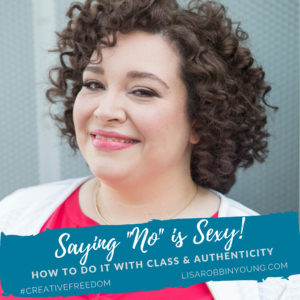 This is Season Four, Episode Four. Where we talk about how to say "no" with class and authenticity. Got someone who wants to pick your brain, ask you for a discount, or - GASP! - work for exposure? Need a classy way to say "um, no thanks!" without burning bridges or sounding like a jerk? You need this episode!
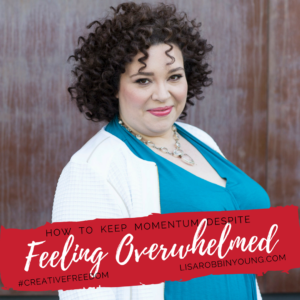 This is Season Four, Episode Three. The overwhelm episode. Overwhelm is a common trap for creative entrepreneurs caught in an underearning cycle. What can you do when you're knee deep in a project (or multiple projects) and have to keep going? Lisa shares what she learned running her first (and only) 10-mile foot race about how to keep momentum when you get overwhelmed.
 This is my second appearance on Mike Michalowicz's popular show. He's a funny guy, and his co-hosts keep things hopping. Mike's the guy who wrote The Toilet Paper Entrepreneur, The Pumpkin Plan, Surge, and, yes, Profit First. His new book, Clockwork will be out this fall.
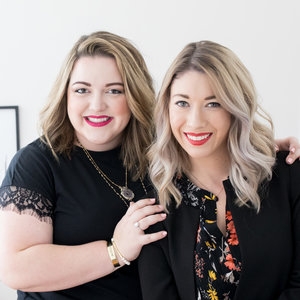 This was my first (and hopefully NOT last) appearance on The Strategy Hour with Abagail and Emylee. These two are a powerhouse combination of business smarts and compassion for the creative entrepreneur's lifestyle. We talk about the importance of striving for a six-figure business - or not, and the rare reasons why you may not need to aim that high. We also dig into the Cusp types - something I don't get to do very often when talking about the Creative Entrepreneur Type Spectrum. If you're a cuspy, this could be some great learning for you.
 I love me some Charlie Gilkey! I was lucky enough to be a guest just as the Creative Freedom Spectrum was coming into the world, so when they asked me back as a contributor, I was thrilled!