How ya liking the new website? Have you checked out the virtual card deck or taken the new version of the quiz yet? I haven't done a formal post yet about all the changes. That's coming soon. Right now, I'm coming off the high that is Creative Freedom Live. I got home earlier this week, and it's been fun to unwind and "recover" from such an amazing weekend. More on that later, too!
Today, though, I'm going to do my darndest to make business models approachable and easy to navigate. Just hearing the word “business model” can conjure up spreadsheets, process diagrams, flow charts, and other stress-inducing imagery. But business models don't have to be stressful.
Once you figure out your unique business model, you’ll like how sexy the results are: more money, meaning, and impact. More Raving Fans for your work, more freedom, and more time to focus on what’s truly important to you.
The best part? It isn’t hard to figure out. The hard parts are sitting down to DO the work and then staying true to the business model that works for you. If you follow along today, you’ll even have some of that handled, too.
Rising Tide community members can login and access your free downloads here.
Not a member yet? It's free! When you register for the Rising Tide, you also get email updates, the FREE learning library, and access to episode transcripts, worksheets, and more!
Special thanks to our Patrons for your continued support.
Music: “Welcome to the Show” by Kevin MacLeod, incompetech.com. Music licensed under creativecommons.org/licenses/by/3.0/
I can't tell you the number of times I've seen "make six figures" come up on someone's annual goals. When I was a young entrepreneur, it was one of my goals more often than I care to admit. It felt like something I should be doing. Shouldn't every creative entrepreneur have a six figure business? Isn't that the goal? To make more money, have more fun, and enjoy life in the process?
Well, yes and no. (more…)
If you're like a lot of creative entrepreneurs, you might still be scrambling to put your goals down on paper for the year. In fact, several guru-types are only just now getting around to leading those goal planning workshops. The folks in A-Club and the Incubator did their annual planning before December, so that they could hit the ground running this year. I'm not bragging (well, okay, maybe a little), I'm trying to illustrate a point that the longer you wait to set your goals, the longer it will be before you can achieve them.
But even if you're only just now getting around to it, there's still one thing you've got to remember to do before you shore up your plans for the new year. (more…)
Marvel just dropped the official trailer for the upcoming film, Avengers Endgame. Filming began in August 2017, in the can since January, and in post production since October. Fans have been dropping concept trailers since August. But the current release date is scheduled for the end of April, 2019!
You can't buy tickets this early. So why drop the trailer now?
Yes, it takes time to edit a film, but not 18 months! The Marvel Cinematic Universe is a carefully choreographed series of content pieces that all work together on one timeline. They are released in a particular order that synchronizes with every other piece of content: film, television, etc. They tease future films in current ones, so you get a taste of what's to come. There are over 20 films already released in this series, with at least 15-20 more in the works (not to mention the numerous television series that are also interconnected to the film storylines)!
Disney also intentionally delayed the release of this trailer after the death of former President Bush. Disney insiders said they wanted to capitalize on the anticipated record-breaking buzz they'd get from the trailer release. If they released on a national day of mourning (when the markets are closed), they'd get very little financial benefit from dropping a FREE video clip.
The buzz created from record-breaking video views means an increase in stock price for Disney and their shareholders. They weren't about to miss out on that!
While you may not have a bunch of shareholders, you DO have a vested interest in watching what Disney is doing with Marvel's Avengers. They know how to create buzz and drive demand for an offer - even if that offer is a $10 (or $20) movie ticket.
Here's the thing: all that content comes directly from the film itself (and the people in it)! They're not re-inventing the wheel and trying to crank out a bunch of unrelated content to sell movie tickets. They're giving you some of the best bits of the movie (including the actors) well before the release date in order to entice you to buy a ticket and see the whole thing!
You need compelling content to be able to maintain that buzz for the long months between the start of filming, the first trailer release, and opening day at the box office. Certain media outlets get exclusive behind-the-scenes access during filming. The actors and directors book interviews and use their social media to talk up the film from shooting through opening day. Disney releases trailers and special behind-the-scenes clips to keep fans talking.
The more fans talk, the more fans watch. The more fans watch, the more fans talk. Good or bad, like it or not, the buzz keeps going, which means higher box office sales on opening weekend.
Granted, you may not have multiple offers to choreograph like Marvel does, but it's still important to plan ahead when you're marketing and selling your offers. Do you need 18 months to sell your next big thing? Maybe, maybe not, but a solid content marketing plan can make the difference between shoddy sales and blockbuster results.
What if you could take a closer look at the elements of your offers and tease out the most compelling bits to share with your audience BEFORE your release date? What if your content could build buzz with your fans and get people talking about your content (and by extension, your offer) in advance, so that when you're ready to start selling, people are lined up and ready to buy, and is when using social media is great for this, since people use social media everyday now a days, even more apps like Facebook or Instagram, and you can click here to learn more about this and get the best resources for this.
That's what we're talking about this month in my Accountability Club! On Saturday, December 29 at NOON Central time, we're going to take a closer look at how Marvel and many of today's big names in entertainment, use different types of content to build excitement and drive demand for their projects. We'll also look at how you can use that same approach for your own upcoming offers.
If you're not a member, then you need to be on my email list to get the zoom link to join us!
You're going to learn:
* How to pull your content marketing material directly from your existing offers - regardless of your industry.
* 7 types of content that Hollywood uses to great effect - and how to do the same for your own offers.
* my exact process for generating as much content as possible in as little as a few hours.
* plus, access to the VERY SAME document I use that makes it super easy to keep your ideas organized.
* And a sneak peek at MY content marketing plan for A-Club next year!
This is a WORKSHOP. Which means, you'll be working on your own plan with me during the session. As such, we're probably going to run a little longer - about 90 minutes instead of our usual 60. You'll be able to ask me questions and get suggestions for your specific plan... but only if you show up to the live workshop!
This is the LAST time I'm offering live access to A-Club training at no cost. I'm creating some new free training opportunities for next year, and as a result, A-Club will no longer be open to the public. If you're not a member, the only way to get access to this workshop and the downloadable worksheet is to be on my email list. Details will go out next week,
In our last episode, I shared some tips to know if an event is worth attending or not. This week, it's only fair I offer some tips and lessons learned from my past 10+ years of doing live events. From basic teleclasses and online concerts to big, multi day virtual and in-person events, here are 8 lessons I learned - the hard way - that can save you a LOT of headaches and lost money when planning your next live event.
Update: Creative Freedom Live is filling up! We've got 2 private rooms left for the event. If it's a good fit for you, I'd love to see you there!
Share your thoughts and ideas in the comments. Your insights may spark a conversation that helps someone else!

Mentioned in this episode:
If you haven't already downloaded this week's bonus content, you'll want to do that here. Not a member yet? It's free! When you register for email updates, you also get access to episode transcripts, worksheets, and other downloadables!
Fashion jewelry from Kerianne at FancyBargain.com. Tell her you saw her bling on Creative Freedom!
Music: "Welcome to the Show" by Kevin MacLeod
Licensed under Creative Commons: By Attribution 3.0
This one’s all about the dolla billz, baby! Many creative entrepreneurs get emotional when it comes to price increases. So, what if there were an easy, external way to know that it’s time to raise your rates?
What if there were 11 ways?
Your wish is my command! Here are 11 external indicators that can help you determine if the time is right for a price increase in your creative business.
Need help communicating that price increase? Consider joining us for the Creative Freedom Guide To Overcoming Underearning, and build your confidence in changing your pricing!

Share your thoughts and ideas in the comments. Your insights may spark a conversation that helps someone else!
Mentioned in this episode:
If you haven't already downloaded this week's bonus content, you'll want to do that here. Not a member yet? It's free! When you register for email updates, you also get access to episode transcripts, worksheets, and other downloadables!
Fashion jewelry from Kerianne at FancyBargain.com. Tell her you saw her bling on Creative Freedom!
Music: "Welcome to the Show" by Kevin MacLeod
Licensed under Creative Commons: By Attribution 3.0
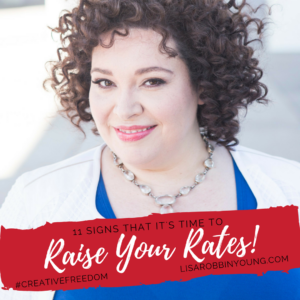
This is Season Four, Episode Five. This one's all about the dolla billz, baby! Whether you've raised your prices in the last year or the last month, it could be time to raise them again if they didn't go high enough in the first place. Many creative entrepreneurs get emotional when it comes to price increases. So, what if there were an easy, external way to know that it's time to raise your rates?
Your wish is my command! Here are 11 external indicators that can help you determine if a price increase is right for your creative business. Need help communicating that price increase? Consider joining us for the Creative Freedom Guide To Overcoming Underearning, and build your confidence in changing your pricing!
Download Season 4 Episode 5 | iTunes | Anchor | Stitcher
If you’re listening to just the podcast, you’re only getting about a third of the deal. Catch the Creative Freedom web series or join me on Facebook on Fridays at 5:30pm Central time for a LIVE Q&A about the week's topic.
02:21 - Why working for free is problematic, and why you might be inadvertently "programming" people to ask you to work for free.
06:31 - How a client in an economically depressed community managed to raise his rates.
11:00 - When someone is playing "Moneyball" with you, it is time to raise your rates!
16:30 - The "tuna can" tactic that helps you raise rates without changing your current pricing.
19:07 - How to look at barter/trade differently.
22:00 - The power of a $25k offer.
Click here to join our Rising Tide to get email updates, transcripts, and bonus downloadables only available to members.
Mentioned in this episode:
Music: "Welcome to the Show" by Kevin MacLeod
Licensed under Creative Commons: By Attribution 3.0
One of the scariest topics for most of my clients - the one that brings with it the most baggage and emotional upheaval - is pricing. Right now, about half of my Incubator clients are stalled out on the decision to raise their prices. As early-stage entrepreneurs, there's a struggle between wanting to earn more and not being convinced that they can/"should" raise rates, for fear that they can't get enough clients to pay them the higher rates when they've been struggling at a much lower rate for a while. What they don't realize is that those lower prices are appealing to the wrong kind of audience, and until they can clear their head trash, they'll stay stuck at the lower pricing.
Although I've used the phrase before, I don't believe you can really charge what you're worth. First of all, you're a priceless masterpiece. No one can define your worth. They can, however, decide how much their willing to pay for your Great Work. You can influence that decision, but ultimately, it rests with the buyer. So it's less about charging what you're worth and more about telling a compelling story so that potential buyers are willing to pay your asking price. As Tara Gentile says "Pricing tells a story". So what story does your pricing tell?
More often than not, pricing brings out a lot of hypocritical behavior. This week's episode explains how your inner hypocrite could be running your business into the ground.
Have you had moments in your business where you said one thing was important, but your actions revealed some other motivation? Have you experienced this "out of integrity" moment with other business owners? How did you handle it? Share your thoughts in the comments and be part of our Rising Tide.
Need support for your creative business? I have two openings in the Creative Freedom Incubator. Applications are accepted on a first-come, first served basis. If you're not ready for that level of hands-on help, join the growing community of supportive creatives in A-Club. We're here to help you grow.
How is it that one creative entrepreneur can have "instant success" while another puts in years of effort with little financial success to show for it?
If that's a question you've ever asked yourself, you're gonna LOVE this week's episode! I've talked at length before about the myth of the big break, and the myth of "overnight success". I'll probably talk more about it in the future, too. There are different definitions of success, however, so let me be clear. Today I'm talking about financial success.
You can put in way more than 10,000 hours toward your craft and still not be financially successful. Even if those hours are "deliberate practice," there are a series of steps every creative entrepreneur must go through in order to turn their craft into a well-paying career. There are lots of options at each of those steps, so what you choose will likely look different than anybody else, but the steps themselves are static. Meaning, you can't achieve financial success until you accomplish these three things. Let Peter Gabriel, Dale Chihuly, Danny DeVito, and Thomas Kinkade illustrate:
This is one of the most interesting take-aways from the work I'm doing for my upcoming book. Every creative entrepreneur that finds financial success goes through these three stages of business growth. Every single one of them. Some move quickly from one stage to the next, while others struggle for a while at one stage or another. But every one of the creatives I've interviewed or researched (again, I say, EVERY ONE OF THEM) went through these three stages to achieve the financial success they desired.
What's that thing that you do best? Not "better than everyone else," though that can help set you apart faster. More like "better than anyone else in your circle of influence." You're not looking for the thing that only you can do. If you have that, cool, but so many creatives get hung up on being completely unique. It's actually better and easier to find the thing you do really well - even if someone else does it, too. Because then you can put your twist on it and still give people a point of reference. The point of reference makes it easier for people to relate to you. Being completely unique requires a lot of extra time and energy to educate your potential audience. Being similar, but different, makes it easier for people to "get" you.
Plus, when you're similar, but different, it helps colleagues and collaborators work with you, refer to you, and spread the word about your awesomeness. You're no longer an army of one, trying to do it all yourself. Instead, you've got a growing network of people that know you, like, you, and trust you, that want to collaborate, rather than compete with you. Collaboration makes almost everything easier, because you can share the load... something most creatives have a hard time doing, but when they do it, the rewards are often exponential.
While it's fun to create for yourself, it's hard to make a living if you're not also creating for an audience. That doesn't mean selling your soul, being a "sell out", or taking on clients just because you need cash. Instead, it means interacting with your fans and followers, hearing their feedback, and responding to your audience in a way that works for you. It means cultivating relationships with people who appreciate the work you're already doing, want to see more of it in the world, and are willing to invest in your Great Work.
My first newsletter went out to 7 people, and I know at least one of those people is still on my list, some 10 years later. We've emailed, chatted on Facebook, and she's purchased from me a time or two. When she has something to say, I listen. I don't always agree, and I am still able to respect her thoughts and ideas. Sometimes I use them, sometimes I don't. I maintain creative control of my work, and I am not so arrogant as to think that my way is the only way.
Listening and responding to your audience isn't selling out, it's an act of courage that helps your business grow. (Tweet this!)
If I've learned anything working with clients in my Incubator program, it's that different creative entrepreneurs need different kinds of support. Some need very specific, detailed, step-by-step instructions, while others can do big things with a rough overview. One of my clients launched an online school (with two courses!) in less than a day, while another took weeks to build and implement a single marketing tactic. While the kind and amount of support you need may be different from the creative entrepreneur next door, you'll still need SOME kind of systems and support. Most of us need an email system. Most of us need some kind of time management and planning tools. You might need marketing support, or customer service support from salesforce admin, or social media support. The key here is to uncover what you really need and get it handled without over-systematizing.
Believe it or not, too many systems can be a bad thing, and yes, you can try to systematize too soon. I see it all the time. Systems and supports are meant to smooth things out. Yes, they can be bumpy at first, while you're ramping up, but if your systems and supports are slowing you down unnecessarily, then you've got too many - which can cause your business to struggle in an entirely different way.
It takes about a year of concerted effort to handle each of these. A year to hone your offer, a year to build your audience, and a year to get the right balance of systems and support. Can you shorten this time frame? Sure. Linears tend to over-systematize, Chaotics tend to be more focused on their offer, and Fusions tend to obsess over their audience (take the quiz to determine your type). If you can get out of your own head, or if you've got a team or a coach to turn to with expertise in these areas, you can shorten that window to as little as a year, maybe less. That also means a lot of hustle. Not everyone is cut out for that kind of hustle, and I don't generally recommend it, because of the number it can do on your health and well-being. But most creatives don't want to hear that it's going to be another three years before they're making good money doing what they love, so if you've got the bandwidth and the intestinal fortitude, go ahead and shrink that timeline. Just be sure you can manage it without burnout, or you'll end up in a start-stop cycle of feast and famine that could drag on for years (this girl speaks from experience, yo!).
What say you? Where are you at in this 3-year plan? Have you been bumping into walls for a while? What did you do to break through? Share your thoughts and ideas in the comments and be part of our Rising Tide!
Ready to get some support to grow your business? Enrollment for Accountability Club is now open, and we'd love to have you inside our hallowed halls!
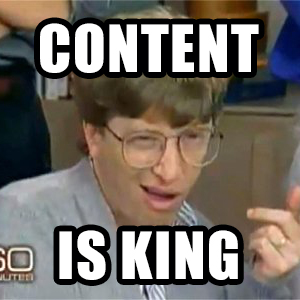
Back in 1996, Bill Gates wrote an essay for Microsoft insiders stating that Content was King – meaning that as the internet advances, it will be imperative to deliver timely, useful content in whatever form the platform demands. It was a statement so general that it easily became a meme for CEO's across the globe, and still lingers to this day as a key reminder that what you have to share better matter to the people consuming it.
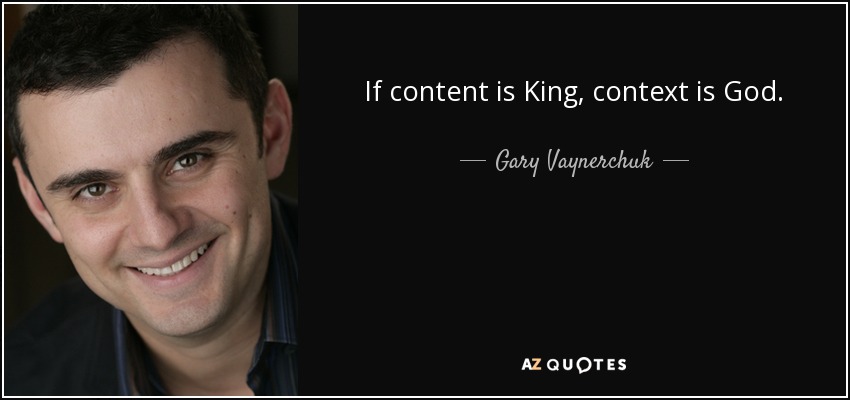
Fast forward 30 years, and Gary Vaynerchuk offers this addendum: "Content is king, but context is God." He invites his audience to consider the medium and the platform as much as the content itself. Make sure that what you're saying and sharing makes sense in the context of how the audience is showing up. Don't start singing “Figaro” at the top of your lungs during a dramatic reading of Hamlet, for example. Don't sell tickets to your event at someone else's grand opening.
And yet, that's exactly what so many marketing messages do today. They interrupt us. They try to “grab” our attention. There's nothing subtle about them – which makes us feel slimy, smarmy, and out of integrity if we feel like that's the only way people will buy from us.
"Hey! Buy my stuff! It's on sale for hella cheap!"
"You'd be crazy not to buy this RIGHT NOW!"
"We interrupt your Facebook feed to bring you this useless advertisement..."
But there's a better way. One that keeps us in integrity with our values and still invites our audience to invest with us. One that still puts money in our pockets, pays our bills, and let's us be a force for good in the world. You can use it on any social media platform, in your email, and any other place where you might find yourself using marketing messaging on a regular basis (during the merch pitch at your concert, perhaps?)
By paying attention to the context of your audience – and providing content that meets them where they are at – you can draw them in – lead them through an experience that makes them eager to say yes to your offers without feeling like they've been marketed to.
There's a difference between an editorial/content calendar and a marketing calendar. Editorial calendars support your marketing efforts. So once you know what you're promoting at different times of the year (your marketing calendar), you can set themes and develop content that supports your promotional efforts. If you're not developing content, you probably don't need an editorial calendar.
That said, most of my readers ARE creating content – shows, videos, blog posts, sales presentations, classes, etc. And you're not just creating content for the sake of producing more stuff. I believe that you're hoping that content will ultimately lead to more sales of your stuff.
Not every piece of content needs to be for marketing purposes.
I recognize that there are times when content creation isn't about a set agenda – we post pictures on instagram about our recent trip because we're excited to share our adventure, not necessarily to sell our latest offering. But when you are creating content for marketing purposes, it's important to remember the journey your customer takes in order to decide to buy from you.
Most collegiate business textbooks outline the stages of the consumer buying process. It looks something like this:
This means that, you can use this process to generate your content.
For example, if you sell coaching, chances are good potential clients might not know they even need coaching. So trying to offer a coaching service to the uninitiated might not land well. You may have created an amazing offering, but if your audience doesn't recognize they have a need for coaching, they simply won't buy.
Educating the buyer around the problem has to come first. This is email-level and blog post-type content. This is awareness-building content. It's early stage content for your launch sequence. People have to know they need what you offer before they're going to buy, and your emails, newsletters, and social media posts can go a long way toward building awareness for your solution.
But you can't stop there.
Because even after they recognize they need coaching, why should they choose you? After all, there are plenty of options out there, right? So now, they're going to start investigating options – unless you've already laid the ground work for them that YOU are the only game in town. Quality content helps position you above other options.
Positioning yourself as the go-to choice is the early to mid-stage launch content, your opt-in content, and the opening of your sales and marketing materials. This is where you get to remind people that "yes, there may be lots of options out there, but this content I'm sharing with you now illustrates why I'm the best choice." And if they're still not convinced? That's where you take things deeper.
The more you personalize the content, the more they feel like you get them. Webinars, live streams, teleclasses or one-on-one sessions - any ways you can interact directly with your potential buyers are going to not only position you as the go-to person, it's going to elevate your stature with your client. They've invested time with you, so there's a greater likelihood that they'll choose you when it comes time to buy. There are no guarantees, however.
Because once they've narrowed their choices, they've got to be ready and able to buy. My husband has known for years that he wants a Cooper Mini, but he's not in a position to buy. He's done the research, he's evaluated his options, he's even made a choice, but he's not buying. He's not ready. He's not financially able or willing to make the commitment to buy yet.
You are NOT creating content for that guy. Sure, you want to make a compelling case for buying with you, but your content at this stage should assume the sale. Assume your clients want to buy from you. At this stage, you're mostly re-assuring them that buying with you is a great value. This is sales-page level content, or evaluative consultations, where you make the recommendation at the end of the consult to buy from you. This is your call-to-action content.
However, all call-to-action content is not created equally, and customers today are more knowledgeable than before. As a result, the typical call-to-action triggers fail to achieve the intended results. It's a narrow line between creating a sense of urgency and being aggressive. Fortunately, a few SEO marketing agencies can help you create the right content to get that guy's attention and make the sale.
That's four distinct tiers of content and if you're launching 3 or 4 offers in a given year, that's 12-16 pieces of quality content that you can craft that directly tie back to your offers, leaving plenty of room in your editorial calendar for lots of other content that isn't marketing a specific offer.
Every "problem" has a core solution of making someone's situation even better. So if you're a musician or a painter, it's the same story. How does your work make their life even better? Why do they need what you're creating? Why should they consider your offer over the offers of other artists or musicians? Macklemore still hosts an annual appreciation pizza party for his fans. What are you doing to create a community around you and your Great Work? Your content calendar can help with that.
Go back to the 4-step framework:
There's nothing slimy or icky about reaching out with an average of 1-2 marketing messages per month, especially when they don't feel like marketing messages! And while you may condense your timeline to 1-2 messages per week during a marketing launch, you're still not making your audience feel icky because the content you're creating is actually helping them make progress toward their goal.
I'm leading a call for my Accountability Club members and current subscribers at 1pm Eastern tomorrow. I'll share specific examples of content for marketing, and there's a Q&A session at the end. If you're already on my list, look for an email with details. The call is free to listen live, but only A-club members get access to the recordings. Learn more about Accountability Club and get access to all of last year's training too.
Now that the new year and my birthday are both behind me, it's time to get back into the swing of things. This weekend, I'm auditioning for The Voice (third time's a charm, right?), and we're still rolling full steam ahead on new episodes for Creative Freedom Season Three. If you've got a question you'd like to see me tackle on the show, reach out and let me know.
One of the questions I get asked all the time (at least once a week) is "how do you manage to do so much?"
While it's true I get things done, "a lot" is relative. It's been mostly just me behind the curtain, "hustling" for years (and I've paid the price for that), so I've had to learn how to create a maximum impact with minimal effort. Despite accomplishing much, there are still dozens of things each week that don't happen for me. It can be debilitating to think about what you don't accomplish, but you'll get more mileage out of every day (and do less in the process) if you keep these tips in mind:
This is just a "highlight reel" of what I cover in much more detail in Dreamblazing (which now includes The PEACE System!). It'll get you off to a strong start and help you keep the ball rolling through the year as you move a head on your deepest dreams and desires. Ultimately it comes down to focus and discipline, but that looks different for each of the creative types. When you implement these steps, you'll find more clarity and ease in each day.
I've managed to right-size my to-do list over the years (with tons of practice), and bluntly, saying "no" has been the critical piece to the puzzle.
"Nope. Not gonna do the dishes today."
"Well, I didn't want to take a shower anyway."
"No, I'm not going to sleep until it's done."
If you're on the "hustle and grind" track, you probably know the sound of that kind of "no" very clearly. But there's another side:
"While I'd love to have lunch (so you can pick my brain), I already have a full calendar (a play date with my kid)."
"Sorry. Investing in your five-figure training sounds awesome, but it's not in the budget right now, and no, I'm not going into debt for you."
"No way, Jose! I'm not taking on another job for 'exposure' until my cash flow improves."
"I can't today. This is my day off."
It's another case of ruthless honesty. When you get clear on what really matters to you - in life and work - you have a filter that helps you say yes to more of the right things and no to other opportunities that pop up on your radar that sound sexy, but will distract you from your real goals. But beware, each creative entrepreneur type needs to say no to different things.
Linears need more white space, time off, and personal focus. Very often, they neglect themselves in a drive to reach a result. Not cool. Chaotics, on the other hand, need more stability and (believe it or not) predictability in their schedule - in a way that works for them. Shiny object syndrome can derail their plans quickly (if they even made a plan in the first place), and it's easy for their "go with the flow" behavior to keep them putting out fires instead of looking to the long term. Fusions can get bored even if they're making solid progress. Repetition and routine are important, but can get tedious, so it's important to have space for celebration, time off, and exploring new ideas (while staying on budget).
Creating a list of priorities at the start of the year helps you know what you're driving toward. I teach my clients to set one annual goal in each of the 5 Key Areas of Success, plus a second fitness goal for mental health. Then, they rank each goal in order of importance.
Before you start scheduling plans for the year, you'll already know which goal is the most important. That way, when goals start competing for your time and attention (and they always do at some point), you'll already know which one gets priority. You can take emotions out of the equation and stay focused on the real priority in your life and work. It's easier to say no when stuff pops up that may be fun but isn't in alignment with your top priorities.
Once you've got your priorities worked out for the year, you can break them down into quarterly milestones. What action steps and sub-goals need to be achieved in order to keep you on track to achieve your yearly goal? Some may be ongoing or will require more time to complete than others.

Be clear on your expectations. If your goal is to make a million dollars, you can't assume you'll make $250,000 each quarter. Chances are good you'll make the bulk of that money in the last half or quarter of the year, because of all the other things that have to be in place first.
Same with weight loss. If you've struggled to lose weight for years, it's absurd to expect you'll miraculously start losing 10 pounds every month so that you can be down 100 pounds by the end of the year. The first quarter of the year will likely focus on building habits - and there'll be a lot of falling off the wagon you'll have to deal with. But as the new habits start to stick, you'll start to see faster progress and the avalanche of results - which again, will likely happen in the latter half of the year.
In my opinion, this is a big reason why so many people ditch their resolutions. Aside from not writing down their goals at all, that is. They plan their goal all neat and orderly, assuming they'll stay motivated and make steady progress toward their goal.
That's not how goal attainment works for most of us. Despite the best attempts of most Linears, success is rarely a steady, incremental thing. There's a lot of plot twists, leaps forward, steps back, re-tracing of steps, and then we get forward momentum once we figure shit out.
You'll want to review your goals and priorities quarterly because even the best laid plans can go off track when "life happens." Moving to Nashville was not my top priority at the beginning of 2016. By Summer, however, my priorities shifted when we filed the divorce papers. Nashville then became a top priority for me, so my other goals had to shift.
New episodes of Creative Freedom didn't get done because I had to pack up all my studio gear. The podcast was delayed, but the items that were most important still got checked off my list. Sometimes you have to rearrange your priorities to accommodate your top priority. It happens more often than you might think.
This was something I learned as a direct sales leader that I've used in my own organizations and with all my clients ever since. If you make time for it on the calendar, it has a greater chance of getting done than if you try to squeeze it in between meetings or when you have some "free time" - ha! What's that?
In short, every little thing that's got to be done to achieve your goal needs to be on the calendar. If you're delegating it, then you need to add a follow-up date in your calendar. Chaotics will reel against all this minutiae, but I'm here to tell you that until it becomes first nature, you'll want to create the habit of scheduling everything.
Whatever you use to track your to-do's is fine, just make sure the long-range stuff gets on the calendar. If you're writing a book and you leave it open-ended, that project will keep getting pushed down the to-do list in favor of other more pressing needs (putting out fires). If you want that book done, carve out specific time blocks in your calendar to work on it - and give yourself a small deadline (like completing the first chapter by the end of February). This will create the optimal amount of pressure to help you double your results in less time. Too much pressure, and you'll crack (especially if you're a Chaotic), but just enough of a deadline often primes the pump to get moving. You might even find that you want to finish it sooner because it's taking up so much time on your calendar. Without that visual, getting that chapter done might drag on for months.
Not sure how much time you need to complete the project? Work backwards. This takes longer, but it's worth the clarity it provides. For unwieldy projects, I use mind mapping to get clear on all the elements of the project, and then get as detailed as I can on each step toward the goal. Only then can I see which step needs to come first, second, third, etc. Once I know the first step, I put it on the calendar. If it's a task, I put it on the to-do list as well, but it's important to block out time for accomplishing your to-do's or they simply won't get done. It's one of the reasons I still put "shower," "lunch," and "laundry" on my calendar. If I don't, I'll fill that time with something else and those things won't get done.
I've been writing about this for a few years now, but the research shows that SMART goals are broken. But D.U.M.B. goals are a different story. When you are taking action on things that are doable, understandable, meaningful and believable, it's much easier to stay the course. I've seen it bear out time and again in my own life as well as with my clients.
It's easier to focus on what really matters when what really matters to you is your focus. It sounds like a paradox, but it's not. When you focus on what matters to you, you naturally stay more focused. It's what I call the "video game effect". My boys all love video games and when they start playing, the world around them falls away. World War Three could be going on outside, and they'd never know because they are engrossed in their game. They're focused like a laser on what matters to them. And God forbid you try to interrupt them - if you can interrupt them at all.
For most of us it's not a question of focus, it's a question of what we're focused on. When you can invest more of your time, energy, and resources into what really matters for you, it's naturally easier to stay focused. Plan your year around what really matters to you and you'll have a natural advantage when it comes to achieving those goals.
Join us in Dreamblazing. It's more than a planner. It helps you define your goals, get them in priority order, and lay out a path to achievement. If you want to be more confident, have more clarity, and be focused this year on what really matters, give yourself the gift of Dreamblazing.
We're a few episodes into the new season of Creative Freedom, and I'm giddy at the overwhelmingly positive response at this season's show. Fingers crossed I don't jinx anything along the way.
Getting to this point wasn't easy. As I alluded to in Episode One this season, I took a LOT of time off. The last show of Season One aired near the end of August. That's almost a year between episodes, and I'm sure that at least one person thought I wasn't coming back.
Well, I'm back with a vengeance, and an upgrade to boot. But not every upgrade happens with ease. In fact, most of the time, there's a desire to upgrade BEFORE you're ready to actually take the plunge. That's what happened to me.
Here's this week's episode to give you the glossy version. Read on below for the juicy details.
Creative Freedom was actually born from a video challenge that Jason Stein and Rachael Albers launched in a facebook group. I knew I wanted to do more video, but I'd been stalling, and the Wisdompreneurs video challenge was a perfectly-timed kick in my pants to get things going. So I did.
But then life happened, as they say, and by August, there was too much on my plate to keep up with a weekly series. So I pulled back, took a hiatus, and spent time trying to figure out what I really wanted to do next.
As a business consultant to creative entrepreneurs, one of the things I teach is to build your business around who you are and what works for you. I thought it fitting to practice what I preach.
It didn't take long for me to decide that I wanted to do another season. I enjoy video, because it's a chance for me to "be on stage" and help people at the same time. But sitting on a yoga ball in my living room didn't leave me feeling like my best self. I wanted better audio for sure, and hopefully a set upgrade. Then, we decided to buy a house, which meant packing up everything and relocating it. So even my makeshift "set" wasn't going to be available for filming.
We moved and, in the process, I thought I was going to get an office - a studio where I could set up and film a show with better production values. I started painting, and sharing my progress on Instagram. It was exciting to watch the process unfold.
And then life happened again, and my teenager moved back in. He needed a room, obviously, which meant the office was a no-go. It's all good. I set up a mini-office in the fireplace room:

For the most part, it works well, and since this photo was taken, I've added another level of shelving (milk crates ROCK!). But it still doesn't give me a viable space in which to record video. In fact, when I do webinars, I often move over by the window, which works for up-close, talking head-style videos, but doesn't give me the ability to be my fun-loving, arm flailing self.
That, and there was simply no room for my fancy lighting set-up. Last January, I invested in softbox studio lighting so I could film better quality videos. They have a small footprint, but they still take up space, and the angle of the roof in the new house doesn't allow me to get the lighting up high enough to be effective.
Cue the violins.
So my friend and mastermind buddy, Pam offered to store my lights at her place. And then, in a stroke of supreme generosity (or madness, I'm still not sure which), she agreed to let me film this season's episodes at her place. It's an entire floor of studio space, with plenty of room for everything I could possibly need. I could bring the Damn Whippersnappers into that space and do a show, it's so huge.
I got way more than I bargained for... in a good way. I wanted to upgrade, sure, but I had no idea the Divine would bless me with something this awesome.
Still, I wasn't ready for it.
The first season of the show was recorded a bit more, um, on-the-fly, shall we say? It was not uncommon to script, film, edit, and upload the video in a single day. But now, I had to develop and coordinate a shooting schedule. That way, I could film multiple episodes in a single day. It would be impossible, not to mention rude, to just show up at Pam's house and say "Hey! I had a great idea for a video today, let me in so I can film it!"
Instead, I had to be more intentional. I developed a slate of episode ideas for the entire season. I think there are about 45 or so topic ideas on the mind map you see here, in various stages of completion.
Then, I had to script and rehearse each episode before filming. I also had to collect my makeup, wardrobe, video and audio equipment, and any props I'd need for filming, since Pam lives a few miles away. I couldn't just run back home if I forgot something. That meant developing a checklist to make sure I always had everything I needed when I got to Pam's for a day of filming.
Once I arrive at Pam's, I've got about five hours to get it all done. Why five hours? Because I have a kid that gets off the school bus and I've got to be home for him! During the summer, I have more flexibility, but I still want to keep my shooting time tight, to keep my costs low. Pam's "doing me a solid" right now, but one day, I may need to rent studio time, and that has a cost.
Just because it's free now doesn't mean it won't cost later. Being efficient always pays off. (Tweet this)
I set up and test all the equipment. It takes about an hour to set up the lights, get the balance right, and test the audio gear. I am a one-man camera crew for the most part, so it's up to me to make sure things work properly. Sometimes the lights are a little too hot, and I might not catch it until after I've filmed everything. Oh well. Next time. #ProgressNotPerfection
Once everything's up and running, I have to make sure my hair, makeup, and wardrobe work well and actually shoot the videos. I wish I could say that every video happens in a single take, but that would be lying. Shooting the end of this episode took me over an hour - so I only filmed three that day.
I can usually shoot 4 episodes per session. Then it takes about 30 minutes to pack everything up and get ready for the drive home. Why five hours? Because I have a kid that gets off the school bus and I've got to be home for him!
Now I've got a handful of videos that need to be edited, posted, scheduled, and ready for broadcast. Yep, I do that, too. But like I said I enjoy video, and since I'm a Fusion type, I actually do a fair job at it. Plus, I'm not so busy yet that I feel the need to hire it out.
I'm familiar with filming so most of this wasn't news to me. The only variables I didn't know about related to how long it would take to set up and test the lights and sound, but I've done a lot of tech rehearsals for theater, so I had an inkling. Yes, this is a LOT of effort, and I wasn't sure that, once I dove in, I'd be able to maintain it.
Frankly, with everything else going on, I wasn't ready to assume this much responsibility before winter was over. We were moving, and yes, the divorce is happening. Had I launched season two in the middle of all of that, I probably would have had a mental breakdown. I wanted to create a new normal, and in order to do that, you have to be ready to maintain it - or it isn't normal, is it?
The next time you're chomping at the bit for an upgrade, ask yourself if you're aware of the new responsibilities that come along with the upgrade. Then ask yourself if you're ready to do what it takes to maintain your "new normal".
The answer might surprise you.
What do you want to upgrade? What's waiting for you on the other side of your next upgrade? Are you READY for that new level of responsibility? Share your thoughts and ideas in the comments, and be part of our Rising Tide Community.
First things first:
I'm THRILLED to announce that the Creative Freedom Entrepreneur Types made their public debut this week over at Charlie Gilkey's Productive Flourishing blog. If you're a creative and you're not familiar with Charlie's work, I highly recommend checking him out.
My guest post is an excerpt from my book, detailing the 3 different types of creative entrepreneurs, along with the process I used to get clear on my target market (which is what started me on this research journey in the first place). Please take a moment to stop in and leave a comment or share the post. The more creatives that we can reach with this message, the better the world will be. I truly believe that.
Also, my accountability partner, Winnie, just posted my interview for her podcast, where we dive into the nature of assessments in general, and why self-awareness is a powerful tool in building your business. The Let's Talk Tech Show takes the mystery out of all the tech-y tools, platforms, apps, and software that solo-preneurs deal with as they grow their business. If you're a Chaotic creative - or otherwise feel overwhelmed by the tech stuff, Winnie's show is a great place to get some basic understanding in plain English.
Okay, on to this week's episode...
I've known Mike Michalowicz for years now. First as a fan of his work, then as a member of his book launch team, then as an editor of his last book, and one of the first certified Profit First business coaches in the world. Now, I think it's safe to say we're friends. And he's an interesting dude. Like me, he's a guinea pig for all the methods he teaches. As a Linear Cusp creative, he's great at creating and implementing systems, but he's got just enough Fusion in him to make it fun and easy to learn what he teaches. Mike's new book, "Surge: Time the Marketplace, Ride the Wave of Consumer Demand, and Become Your Industry's Big Kahuna," is the next installment of his guinea pig adventures. Using surfing as his framework, SURGE is actually an acronym for the steps you need to take to find and ride your own wave of business success.
Does it work? Watch the episode, then read on:
If you read the book, you'll see plenty of case studies supporting Mike's process - including examples from his own business. As I mentioned in the video, I was a smidge disappointed about the lack of specifics around the "cool kids" strategy, until I realized I did it myself, without really trying.
I've been doing the research on the Creative Freedom Entrepreneur Type spectrum for about 18 months. Interviewing creatives from around the world, analyzing the data, and testing theories. Back in April, Charlie posted on Facebook saying he didn't resonate with particular a social media platforms. I said that it made perfect sense to me because his creative entrepreneur type wasn't a good fit for those platforms. That got him (and a few others) curious, so I explained a little about the research I was doing. Charlie was intrigued enough to have an email convo with me that led to this week's guest post on his blog (and with a little luck, an interview on his podcast later this year).
Luck is where preparation meets opportunity - which typically looks like work! (Tweet this)
Charlie has a solid track record in the realm of creative entrepreneurship. He's one of the "cool kids" in the marketplace. But I had no idea how to get on his radar until HE said something where I had an opening.
There are a couple of things that you need to understand:
This was an organic way to "reach the cool kids" - and it worked. Will it continue to work? Well, I have a few more "cool kids" to check out before I can let you know!
After a LONG hiatus (longer than I wanted, truth be told, but whatever.), Creative Freedom is BACK!
Sound the trumpets, yo. This is a BIG deal for me.
As you'll see in today's episode, we've made some changes. Why? Because I have been changing. My life looks radically different than it did a couple of years ago, when Creative Freedom was only a glimmer in my eye.
I knew what I wanted to do, and I knew it would take time to make it happen. The only thing I wasn't sure of is whether or not I could actually pull it off... and if I did pull it off, I didn't know if I wanted to keep doing it.
Then, in the middle of all my planning and creating - to misquote John Lennon - life happened.
There's more to life and work than "the hustle." (Tweet This)
It took most of the last 12 months just to re-group and care for what was going on around me. And when I was ready to come out of my cocoon, it became more apparent than ever that Creative Freedom is not just a fun title for the show, it's the life I want to champion for other creative entrepreneurs.
How did I get there? Today's episode will give you some clarity around the three things I had to do in order to pull myself together and get my Noble Empire back on track.
I reached out to the members of my Accountability Club to share their genius on this topic as well:
How are you honoring the cycles of your creative life and Great Work? Share your thoughts and ideas in the comments and be part of our Rising Tide.

First, an announcement: Des is BACK from L.A., and we had a great session this week, recording tracks for The Fine Line. We laid the final tracks for our sexified version of Aerosmith's "Dream On" as well as the understated Eagles tune "I Can't Tell You Why." I am looking forward to sharing that track soon with our patrons and sponsors. If you haven't already pre-ordered your copy of the album, you can do that here.
In all, The Fine Line will feature 15 songs, including 2 originals. While most of the songs have been jazzified to some extent, the notable exceptions are a 1950's "motown" version of VanHalen's "Why Can't This Be Love" and a melancholy version of Avicii's "Addicted To You". The entire album is an intimate piano/vocal affair, and Des and I are hard at play to deliver the pre-orders in September.
Here's a sneak peek at the new album cover. What do you think?
You probably don't need me to explain that it's a double visual metaphor - songs from the past into the future, and "the fine line between the American Dream and the American Nightmare" as Don Henley once said.
Also, I gotta give props to Heidi at HSB photography for doing an amazing job on the photo shoot!
Okay, now on to the post!
As a creative entrepreneur, I used to struggle with day-planners, schedules, and anything that came with too much structure. That's my Chaotic side lashing out at my need for a little bit of Linear sanity. Since none of the traditional tools worked for me, I developed my own back in 2009, thinking it would probably go on the heap of "tried and failed" attempts to get my life and business squared away.
Well, here we are, 6 years later, and it still works like a charm. I've tweaked it a little over the years, but the core steps have stayed the same. This week's episode of Creative Freedom reveals my simple 5-step PEACE System that keeps me on track every day - focusing on what really matters, and giving myself permission to let go of what doesn't move the ball down the field.
Oh, and you'll hear one of my all time favorite tunes from a now defunct 80's band with a drummer that used to write songs with Madonna.
It's just enough structure that Chaotic creatives can play around and keep things loose, while giving Linear creatives the ability to get as granular as they need to stay sane. Fusion creatives like me can be flexible, depending on the kind of day we're having. I really surprised myself when I developed this concept. It's something I've been able to stick with for years now, and I attribute much of my success to using it - and I attribute much of my failure to the times when I get lazy and don't use it!
Not sure about your Creative Freedom type? Be sure to take the quiz and find out.
What works for you? What have you tried that didn't work? Share your comments
Recently, a new subscriber reached out and asked me about uncovering her "Great Work" in the world.
First of all, I LOVE it when people email me their questions! If you've got a question, hit me up in the comments or send me an email.
But to answer her question, I had to look deeper at what she wrote. Turns out, she's one of those "Jack of all trades" kinds of people. You know the type: someone who makes you sick because they're really good at a lot of things... but they can't figure out what their ONE THING is in order to make a career at it.
Oh, I know this problem so intimately well... because I'm one of those people.
For years I worked with coach after coach who told me to pick one thing, focus in on one thing, and get good at one thing and let THAT become my income driver.
Problem: Getting good at something isn't an issue. I'm a quick study and can pick up a LOT of things quickly. Then, my learning addiction kicks in and compels me to go deep in the topic so I'm GOOD at it, too.
Yeah, it's kind of annoying to me also. hee hee.
Over the years, I've had so many jobs and career paths that I was starting to think something was wrong with me... but there's nothing wrong with me. In fact, I'm part of a rising number of people that I call "Fusion" Creatives.
With a rise in demand for Liberal Arts and General Studies type degree holders in the workplace, we're seeing a resurgence of "renaissance" types who are versed in a variety of topics, and can hold their own in multiple environments.
Like being at the nexus of creative entrepreneurship, for example.
As a musician and a business coach, I've been pressured for years by coaches and peers to hone in on one thing... but that's like asking me which of my kids gets to live in a sacrificial offering. Not gonna happen. I'd cut out my own heart first.
...but the world hasn't been ready to deal with us until recently. Books like Barbara Sher's "Refuse to Choose" have helped give credence to "Scanners" as she likes to call them. We're not flighty, we're actually incredibly valuable - even if we have a hard time seeing it ourselves.
This week's episode of Creative Freedom unveils a glimpse into this
Fusion types often think of themselves as not creative when compared to their Chaotic friends and colleagues. Chaotics are the type we most often think of as the "creative" people of the world. They can be artsy, or crafty, free-spirited, and willing to "go with the flow". Chaotics are also pretty good with people, communication, and have a strong connection to their definition of the Divine. Some people call them "right brained" but that's a misnomer that's been debunked in recent years.
So us Fusion types tend to feel a little "less than" when compared to our Chaotic colleagues.
Fusion types also find that they're the "creative ones" when compared to their Linear colleagues. Linears are the type that think more strategically, enjoy working with patterns, numbers, and figures, and often find themselves at a loss when it comes to building strong relationships, networking, or handling customer service issues. Some people call them "left brained" but - as you can guess - that's a misnomer, too.
And yes, Fusion types tend to feel a little intimidated (or overwhelmed) when comparing themselves to their more financially successful Linear colleagues.
But I said "potential" and potential not acted on is wasted. Fusion types can be good at just about ANYTHING. They just need to hone in and stay consistent, while having the courage to keep sharing their unique blend of Linear and Chaotic awesomeness. Chaotics marvel at Fusion's ability to stay on track, meet deadlines, and generally get stuff done (as a one-woman show, I might add). Linears appreciate the creative streak and courage Fusions have to be "on" with people.
In short, we're pretty freaking awesome, and we have a hard time seeing it because everyone around us is more Linear (or Chaotic) than we are. So instead of seeing our unique blend as fantastic, we worry if we'll measure up.
But when we DO finally stay consistent, we are the Creative Freedom type with the greatest capacity for financial and personal success.
Each type also has blind spots that slow down their trajectory. For Chaotics, it stars by having a choke hold on your creative vision. For Linears, it's being too focused on bottom-line results. For Fusions, it's perfectionism and comparisonitis that keeps us stuck.
When you learn your Creative Freedom type, you shine a light onto those hidden areas so that you can take action and see success more easily. I stumbled on all of this entirely by accident over years of working with clients and noticing the patterns they were demonstrating.
If I did my math applying the 10,000 hours concept correctly, it takes about 10 years of consistent effort to reach world class status. At 40, I should be world class at about 4 different things, if I applied myself properly over the years. That means, I've got another 30-40 years (or more) to master a few more things. Heck, even Tony Bennett has established himself as a painter as well as a singer!

Fusion creatives don't need to pick just one thing. YAY! Instead, we need to think of our talents like a rock band - like the Eagles: you've got a lead singer, and others singing backup. Everyone in that band sings at some point in the show - and they've all got years of practice at honing their craft. No one is ignored, and they all get to shine.
THAT is how a Fusion makes the most of their gifts and talents. Put one or two out front while the others provide "back up" and have the courage to experiment and rotate them out from time to time - just make sure you keep practicing and honing your craft before you make a big leap. You don't see the Eagles trying something new at their shows - that's what rehearsal's for.
Have you been the Jack of All Trades in your circle? How have you created a meaningful body of work with your skills and abilities? Did you take the quiz and learn your Creative Freedom type? If so, what is it? Share your thoughts and ideas in the comments and let's be a rising tide for everyone!
(NOTE: I'm just about finished with the Creative Freedom entrepreneur type quiz. If you're not already on my mailing list, subscribe [in that handy box above] and be the first to get access!)
This summer, I've been channeling my inner crafty woman. I'm a pretty good singer and speaker, but I never really thought of myself as creative - as in making things - until I married a guy who decorates our Christmas tree with origami cranes.
I fiddled around with drawing as a kid - but my cousin was a much better artist. In fact, I could pretty much guarantee that someone I knew was better at any crafty thing than I was.
Turns out, that's part of my Creative Freedom type. I'm a Fusion, which means that I can always find someone more creative, more strategic, and more "better" than me if I look hard enough - but that's because my life is filled with a mix of awesome Chaotic and Linear Creatives, who will always be further along on the spectrum than I am. Fusions, on the other hand, sit right in the middle of the spectrum, which means we can do lots of things other people can't. It's why our analytical friends call us "the creative one" and our creative friends call us "the smart one."
This is just part of what I've been exploring in preparation for the launch of my new book "Creative Freedom." Once I learned I was a Fusion type, it gave me permission to embrace ALL the ways I'm crafty and creative. Finally, a place where I don't have to choose, I can just enjoy being me!
And I made an origami daffodil to prove it! It's my first attempt, and I used a plain sheet of paper instead of origami paper, so it's a little wonky, and I'm proud of it!
There's another reason I'm sharing this daffodil with you, and it has to do with a story that goes back about 20 years. You may have heard of it. It's called "The Daffodil Principle" by the late Jaroldeen Edwards.
But before I get there, let me tell you why I'm sharing this story.
I got an email from a reader who has been struggling with building her Noble Empire because of some stuff she's been dealing with in life: health, money, family... you know.. life stuff. She's a little frustrated and overwhelmed about wanting to be further along on her dream, but also stuck in the reality of where she's at.
Which brings me to the Daffodil story.
Jaroldeen's story is actually about a real garden in Running Springs, CA, designed and planted by Gene Bauer - a lifetime effort spanning more than 50 years. Every fall, at her vacation cabin, Gene would plan and plant each bulb by hand. When she started, she didn't even know which end was up.
Can you relate?
As creative entrepreneurs, sometimes we don't know what direction we're going - let alone if it's the right one or not. But Gene's an example of just showing up, year in and year out, and letting the creation unfold into a life's work. Most people don't know Gene was actually a teacher, and planting daffodils was just an interest, that became a hobby, that became a passion.
This week's video tells the rest of the story - the part that happened after Jaroldeen wrote her story - and I think it's probably even more powerful than the original, because of how the Bauers had to overcome adversity when fires besieged the property. Oh, and if you watch really closely, you'll get a quick glimpse of New Kids on The Block and a young Marky Mark Wahlberg before he got all grown up.
The more I researched the story, the more fascinated I became. That's part of why I learned to make an origami daffodil - since they're out of season right now (you can also make a stem if you'd like). Gene and Dale even compiled a history of the Running Springs property to give people some background on how the 5 acre plot of land came to be in their hands, and ultimately covered with so many varieties of daffodils.
THAT, to me, is what it means to build a Noble Empire.
What small step are you making? Share your thoughts and ideas in the comments and be part of the Rising Tide. Have a question you'd like to see featured? Hit me up! I love requests!
At the beginning of every year, I sit down with my Dreamblazing program and set my goals - then I review them each quarter.
But they also say that "life happens every 6 months" - and here we are at the middle of the year. It's a great time to make sure you're still on track, and if you aren't here's a reader's digest version of my planning process - including a sneak peek into how Dreamblazing makes it easy.
To help you lay the foundation, I've also included the worksheets from the first day of the Dreamblazing program so that YOU can take stock and do a little review of your own - and set the stage for your future success. Oh, and Hall & Oates help me out with a special "guest spot" - sing along if you know the words!
Whether you use my Dreamblazing process you some other method of planning, make the commitment to complete the entire process - especially if it feels uncomfortable. I see a lot of entrepreneurs (creatives in particular) that start planning, and when things get tough or they feel stuck, they quit. It's fine to take a break and come back to it later, just make sure you actually do come back to it later. Dreamblazing is elxible enough to complete in a single
It's hard to know where you're going if you don't know where you are. It's hard to know your trajectory, if you don't know where you've been. A lot can happen in a year. I lost count of all the awesome surprises that happened to me each year, so I started keeping track, and using the "Evaluate and Celebrate" section of Dreamblazing to remind me of just how awesome my life and work can be. That's particularly helpful when I'm in the middle of a funk, or things aren't going as well as I want them to in the moment.
Evaluation also allows me to see where I missed the mark and need to tighten my focus - or re-calibrate if a goal is no longer applicable.
In my book, The Secret Watch, I lay out the 5 Key Areas (Faith, Family, Fitness, Fortune, and Freedom) - but the way you define them is entirely up to you - which, again, gives you the flexibility you need to develop D.U.M.B. goals. Hone in on what will give you the most cause for celebration at the end of the next 12 months in each of these areas, then you can begin to set milestones along the way to help you know if you're on track to hit them.
If you're following the Dreamblazing program, you'll pick 6 goals to drive for the year, but you've also got to prioritize them. It's better to do that NOW before there's a conflict, because "life happens when you're busy making other plans" as John Lennon famously said. If you don't prioritize your goals, then when an opportunity arises that pits one goal against another, you'll be forced to choose. In the heat of the moment, sometimes we choose what's urgent, rather than what's really important. Prioritizing your goals gives you a filter to run all your decisions through.
And if you change your priorities later, that's fine too.
It takes a little time to develop a solid strategic plan, but it's worth the effort. Whether you use a tool like Dreamblazing or develop your own method of annual planning, it's important to make the plan. Eisenhower once said that "plans are useless", but "planning is everything" - and I think he's right. While many of my plans go awry not long after making them, the fact that I took the time to actually sit down, clear my head, and focus on what really matters to me keeps me moving in the right direction. It also keeps me agile so that when life throws me a curve ball (and it happens more times than I'd care to count), I'm able to respond thoughfully, instead of react in a knee-jerk way.
Plans may go awry, but planning keeps your head in the game when life throws you a curve. (Tweet this)
Shazam! My audition in Detroit for The Voice went better than I expected, although I did not get called back. It's always fun for me to go to "The D" and this time was no exception. I learned some powerful business lessons during my long wait in the audition line (post coming soon), plus I met a childhood friend of Anita Baker who designs Mustangs at Ford! We had a fun time connecting and learning about each other. Hooray for new friends!
Speaking of, this week's video is actually a request from my facebook page. Jessica-Lynn Sage asked about hiring help in your business. Her big concern was in being able to trust someone else to handle the work and "let go" of doing it yourself.
The timing couldn't have been more perfect, since I've been working on my photo shoot for the new album (and website). This week's episode of Creative Freedom gives you the low down on how I sourced and "hired" the team for this shoot.
But there's something else I didn't include in the video that's also important...
In my research, I've been exploring the three different types of creative entrepreneurs (a quiz is coming soon!), and each one has their own sets of challenges. Chaotic Creatives look for people they trust with their vision and the direction they're trying to go as creative individuals. Linear Creatives are more concerned with getting results NOW - and getting the "right people on the bus" as Jim Collins would say. I'm a Fusion Creative, so I tend to walk the line between the two. Results are important to me, but I also don't want people to deviate too far from my vision, so I'm willing to forego some short-term results for a better overall project at completion. Understanding your Creative Entrepreneur type will help you know what to look for in hiring your support staff, as well as your temporary team members, like my photographer and stylist for this shoot.
Like the contract riders rock stars have for "green skittles," Chaotic Creatives want to adhere to the vision above all else - no exceptions or deviations. It's that kind of exacting, demanding nature that makes Steve Jobs both a brilliant mind and a jerk.
Because my vision included some specific shots I wanted, and a certain look and feel, I put together a pinterest board of ideas and inspiration. I put the call out on Facebook for a photographer (Thanks Heidi!). I shared that board with everyone, and made sure they were in sync with what I was trying to achieve. I actually had someone that didn't like my idea - so they were off the team. I knew my direction for the project, and didn't want to deviate.
At the same time, I didn't want to wait around for months to make this happen. We had already been negotiating a shooting date for a few weeks, and I know it takes a bit more time after the shoot to get the raw photos processed. So I really wanted to have it all hammered out before school got out on June 9. When my original venue fell through, the photographer suggested an alternate outdoor location. She recommended and secured a stylist, and we finally booked June 8 (we couldn't have cut it much closer, right?).
Linear creatives tend to focus on structures, routines, and processes. Above all else, don't deviate from the system (versus the vision), because the system works. It's the kind of strategic creative thinking that made Edison a genius in the lab, but a social misfit with his own family.
When it rained the day of the shoot, the outdoor venue wasn't viable, so we punted, opting for an indoor location for almost all of the shots (Thanks, Ted!). The indoor venue provided a lot of great images we couldn't have gotten anywhere else, and my willingness to be flexible on the results made it possible to complete the project without dealing with rescheduling.
A true Chaotic Creative wouldn't negotiate on the details like that, while a Linear Creative would be more interested in meeting the deadline more than the creative vision. I fell somewhere in the middle, allowing for and trusting flow, but still making sure I got the key shots I wanted for the project.
For example, there was one shot I was insistent on having, and if we couldn't do it that day, I was willing to do it another time with another photographer if need be. Gratefully, mother nature cooperated in the end. The skies cleared up and I stood out in the middle of traffic while Heidi snapped the shot that will likely be the album cover. I like to think it was my flexibility that gave us the better weather near the end of our shoot.
Whether you're paying for help, or just getting started with asking for help, whether it's a long-term or short-term hire, you need to be able to trust that your team will do what you've asked them to do. The video outlines a few ideas, but did I leave anything out? What else should Jessica-Lynn know about getting help in her business? Leave a comment and be part of the Rising Tide for all the creative entrepreneurs in our community!
In my early days on Facebook, I was quick to follow anyone with a pulse. If they connected with me as a friend, I returned the favor. I watched my list of "friends" skyrocket to well over 1000 people in very short order.
Problem is, while my friend count was increasing, it didn't result in new friendships... just more nameless faces on my feed. I never had that problem on twitter, though. It moved so fast, I didn't WANT to follow a bunch of people that I couldn't keep up with.
The result? In my first full year of twitter activity, I generated an additional $30,000 in revenues that I could directly attribute to my time on twitter. I'd met tons of people, made great connections, and made inroads on my income goals as well.
And my follower count on Twitter was substantially lower than the thousands I had on Facebook.
That was a valuable lesson for me. Twitter was engaging and it helped me connect with real people in real time. I knew I couldn't keep up with thousands of Facebook friends that weren't really having conversations with me. I needed to cull my list of "Friends" down to the people I really connected with.
I was chasing a magic number. I thought that if I had thousands of facebook followers, it would result in thousands of dollars in income. That wasn't true for me. By chasing a number that didn't really matter to the bottom line of my business, I wasn't focused on results, I was focused on "looking good" - on vanity.
I knew I had to cull my list, but I didn't want my friend count to drop significantly in a single day. After all, I was still hooked on the vanity of having thousands of "friends".
But any number you're tracking that doesn't directly tie back to your bottom line results - numbers that just make you look good, or feel good, are vanity metrics.
Sure, vanity metrics can prop you up when you're feeling low, but over time, you start to resent them.
"Hey! I've got 10,000 friends! Why is no one seeing my posts? Why am I not making any money?"
Then you start to blame the platform, instead of addressing how chasing vanity metrics has compounded your problem.
"Stupid Facebook changed their algorithm, and now no one sees my stuff!"
Often, the problem isn't the platform, it's the way you're using it. If you've got 1000 "friends" that you never talk to, that you never interact with, why should Facebook's algorithm make your posts a priority for them?
...Not that I speak from experience or anything...(insert awkward silence and lots of blushing here)
So over time, I started doing something most people might consider unthinkable. Each day, when Facebook sends me the birthday announcements, I go into the profile of the birthday boy (or girl), and if I don't truly have a connection with them, and it's been more than a year since we've "friended" each other, I unfriend them.
"Happy Birthday! I just unfriended you!"
Now, I don't post it on their wall or make a big stink about it. I just deleted 2-3 people every day until I only had people in my friends list that I actually knew, had conversations with, or were people I wanted to spend time getting to know better.
In all the years I've been doing it, no one has ever grumped at me about unfriending them... which proves my point.
If you have no relationship with your connections, they won't miss you when you're gone. (Tweet this)
While looking at a high Klout score can inflate your ego, what really matters (at least for me) is the trend of that number. Is it going up, down, or staying the same? What does the trend mean for your business? If a rising Klout score means you're connecting with more people, and those people are your perfect-fit customers, then great! On the other hand, if it means you've just been more active on social media this month, then perhaps you need to re-think your business strategy.
Or maybe Klout means nothing to you (like it does for my colleague). What matters is that you're keeping track of the numbers that matter to you and your business in a way that works for you.
Here are a few numbers I track on a weekly basis (with the help of my AMAZING VA), to keep me on track in my business. In some cases, the number is important, while in other cases, it's the trend that matters most:
If I had to track all these (and more) myself, my creative brain would have a meltdown. Either that, or I'd spend more time getting lost in the sites as I collect the stats - which is why I have a VA (virtual assistant) handle most of this data collection for me. My financials (sales, income, expenses, etc.) are still handled on my end. Queen Latifah once said to make sure you are always the one who signs the checks, and I think that's sound advice.
The bottom line is that, in business, you need to be concerned with your bottom line. Depending on your Creative Entrepeneur type, it isn't always comfortable to do it. To be clear, making time to look at the metrics and money doesn't mean you're putting money ahead of people, either. As I've mentioned in previous posts, You've got to have profits, or you don't have a business... it's a charity or a hobby! There's nothing wrong with charities or hobbies, but you need to be clear which it is that you are running and behave accordingly.
What numbers have you been tracking that don't tie back to your results? What ways can you stop chasing vanity and start creating connections, engagement, and more meaning in the relationships with clients, subscribers and fans that you already have? Share your comments and become part of our Rising Tide.
Also, we're considering starting a free facebook group to take these concepts even deeper each week. Interested? Let me know! When there's enough interest, we'll make an announcement in my weekly newsletter. Not on the list? Use the handy dandy box at the top of the page and rectify that problem now. 🙂