
My mother used to pee in a Styrofoam cup at work because there were no toilets.
Her job? She sat in a wooden parking booth across the street from Flint East - one of General Motors' sprawling manufacturing complexes in Flint, Michigan. She'd gotten the parking attendant job through a family friend who owned those lots. Nearly every car parked there belonged to somebody who worked inside "the shop."
There were two booths. Calling them “booths” probably makes them sound more substantial than they were. The smaller one was basically a wooden box with a window, a desk, two chairs and a wall heater.
I was somewhere between ten and fifteen at the time. My siblings and I would help her patrol the lots on evenings and weekends. One day the rain was coming down so hard outside that tiny booth that Mom didn't want to run across the lot to use the bathroom at the corner bar. She grabbed the Styrofoam cup she got at lunch, popped a squat, did her business, cracked the door, and poured it onto the ground.
I watched the rain carry it away almost instantly. WOOSH!
The larger booth, near the main plant entrance, was a little fancier. It had a back room. By “back room,” I mean a storage closet with a bucket you could use as a toilet.
There was a convenience store across the street called Mac's (amazingly, it's still there!) but they wouldn't let you use the restroom unless you bought something. So Mom bought a Diet Coke every day she worked the big booth.
Mom's job was "simple" on paper: walk the lots, check the license plates against the list of people who'd paid, and tow the ones who hadn't.
Some people tried to game the system by backing their cars in so she couldn't see their plate.
Winter was the worst. Sometimes we were out there digging snow away from bumpers with our hands. Mom's gloves would get soggy pretty quickly, so we were bare-handing it most of the time. We worked fast because the sooner we got the plates checked, the sooner we could get back into the booth with the heater.
Mom had no sympathy for the guys who tried to stiff the parking lot. These people were making “shop money,” as she called it, while she was outside freezing her ass off trying to keep us fed.
She wasn't merciless. If there was a genuine health or family crisis, she'd do what she could to keep them from getting towed. But she had a colorful vocabulary for those - ahem - “motherfuckers” (the most printable option) who tried to park and not pay on the regular. If somebody who hadn't paid came out and found his car was towed, she was almost gleeful about it.
To be clear, General Motors didn't employ my mother. She never appeared in any analysis of GM headcount. She wasn't represented in the plant productivity numbers and she wasn't part of the UAW contract.
Those plant workers made her job possible. Every car in that parking lot represented somebody else's paycheck. And those paychecks created hers. That's how living systems work.
I've started calling this the Consequence Gap: The distance between the people who have the authority to make a decision and the people who have to live with what that decision does.
We tend to think of organizational consequences as direct: close a plant and the people who work there lose their jobs.
But that's only the first ripple.
Mom's job existed because those plant workers had jobs. Other businesses existed because they bought lunches, gas, clothes, homes, and Diet Cokes. Their kids went to local schools. Their families paid taxes. Their paychecks circulated through an ecosystem that extended far beyond GM's payroll.
The farther decision-makers get from those ripples, the easier it becomes to believe the spreadsheet tells the whole story.
It doesn't.
Years later, I ended up working inside Flint East myself. I came in as a temporary administrative assistant during the 1998 strike. My first day, I crossed a picket line.
My father was certified Chevrolet mechanic and had a brief stint working for GM. My grandfather had briefly worked for GM, too. One of them was a "scab" but I can't remember who, neither stayed very long. Crossing that line felt uncomfortable as hell on many levels. But I had a kid to feed. I needed the money. That fact mattered just as much to me as the strike mattered to the people standing outside.
I was supposed to stay a few months. I did good work, so they kept finding places for me for a couple of years.
First the site manager's office. Then Plant 6. Later Plant 2, the Delco operation. Eventually I was supporting several managers as the organization kept restructuring.
Once I was inside, I found myself in a weird, but useful position. As a contractor, management didn't see me as labor. Labor didn't see me as management. So people talked around me.
Executives talked in the offices like I wasn't really there. Shop workers were a little more guarded (because technically I worked for “the man”), but not much.
I listened, because understanding why - the context - has always mattered to me.
Depending on where I stood, I heard two very different stories about the same fight. Management talked about costs they couldn't continue carrying. Workers talked about promises, and what they were owed.
Contemporary reporting from the time reflects that same divide. GM argued that work rules and productivity problems were undermining its competitiveness. Workers feared outsourcing and more jobs moving to outside suppliers or lower-cost plants in Mexico. The Flint strikes became so consequential that most of GM's North American assembly operation was expected to grind to a halt.
Everybody had numbers. Everybody had contracts. Everybody had a case.
And the entire city was living downstream from whatever happened next.
That's the part I think we keep missing when we talk about organizational decisions.
We talk about headcount, labor costs, margins and capacity. All of those numbers are real. I use numbers in my own work. One of my tools is literally called the Enoughness Number. It takes all the things you want and need your life to provide and translates them into an annual income target.
Numbers can help us see reality. The problem starts when we confuse the numbers with what the numbers represent.
A spreadsheet can tell you that eliminating 10,000 jobs saves X dollars. It won't show you 10,000 human ecosystems disappearing at once.
Those people have spouses, children and mortgages. They have favorite restaurants, churches, soccer teams, hairdressers, mechanics, and doctors. They mentor people and take care of aging parents. They buy Girl Scout cookies from the kid next door (or their parent who works with them in the shop). They fall in love, break somebody's heart, make art, volunteer, and have ideas that haven't happened yet.
Every one of them is connected to other people. The consequences don't stop at the factory gate. They radiate like ripples in a pond, baby!
SO, those workers are not simply 10,000 units of labor. That number is only the visible edge of the consequence.
When I worked at Flint East, the Delphi spin-off was coming. The prevailing sentiment I heard inside the plant was basically this:
"GM's keeping the valuable parts and spinning the people (and their pension obligations) into Delphi."
That's how shop workers talked about it.
The actual financial structure was more complicated than the shop-floor shorthand, but their concern about the pensions wasn't imaginary.
Delphi became independent from GM in 1999. According to the U.S. Government Accountability Office, its hourly pension plan was only 69.1% funded that year, while its salaried plan was fully funded.
Delphi entered bankruptcy in 2005. By 2009, the Pension Benefit Guaranty Corporation took responsibility for six Delphi pension plans covering approximately 70,000 workers and retirees. At that point, the hourly plan was underfunded by about $4.5 billion and the salaried plan by about $2.7 billion.
I worked in financial services before moving back to Michigan. I was young, but I knew enough to understand that an underfunded pension was not some abstract accounting problem. At that scale, it was a disaster waiting for people to retire into it.
The old-timers knew it, too. A lot of folks were hoping for a buyout so they could retire before the spinoff and keep GM benefits. People worried about whether they could protect the retirement they'd spent decades earning.
Again: numbers on one side. Lives on the other.
I haven't physically driven past Flint East in years.
The last time I saw it in person, some buildings were empty, but there were still buildings. The parking lots across Dort Highway, where Mom worked decades before, still looked like parking lots.
Today, I pulled it up on Google Maps.
Most of the complex is gone.
Concrete slabs. Vacant land. Trees growing through cracks in the remaining foundations where factories once stood. Not just shrubs - trees!
A tree doesn't grow through an industrial foundation overnight. A tree means time. It means nobody disturbed that patch of ground long enough for nature to start reclaiming it.
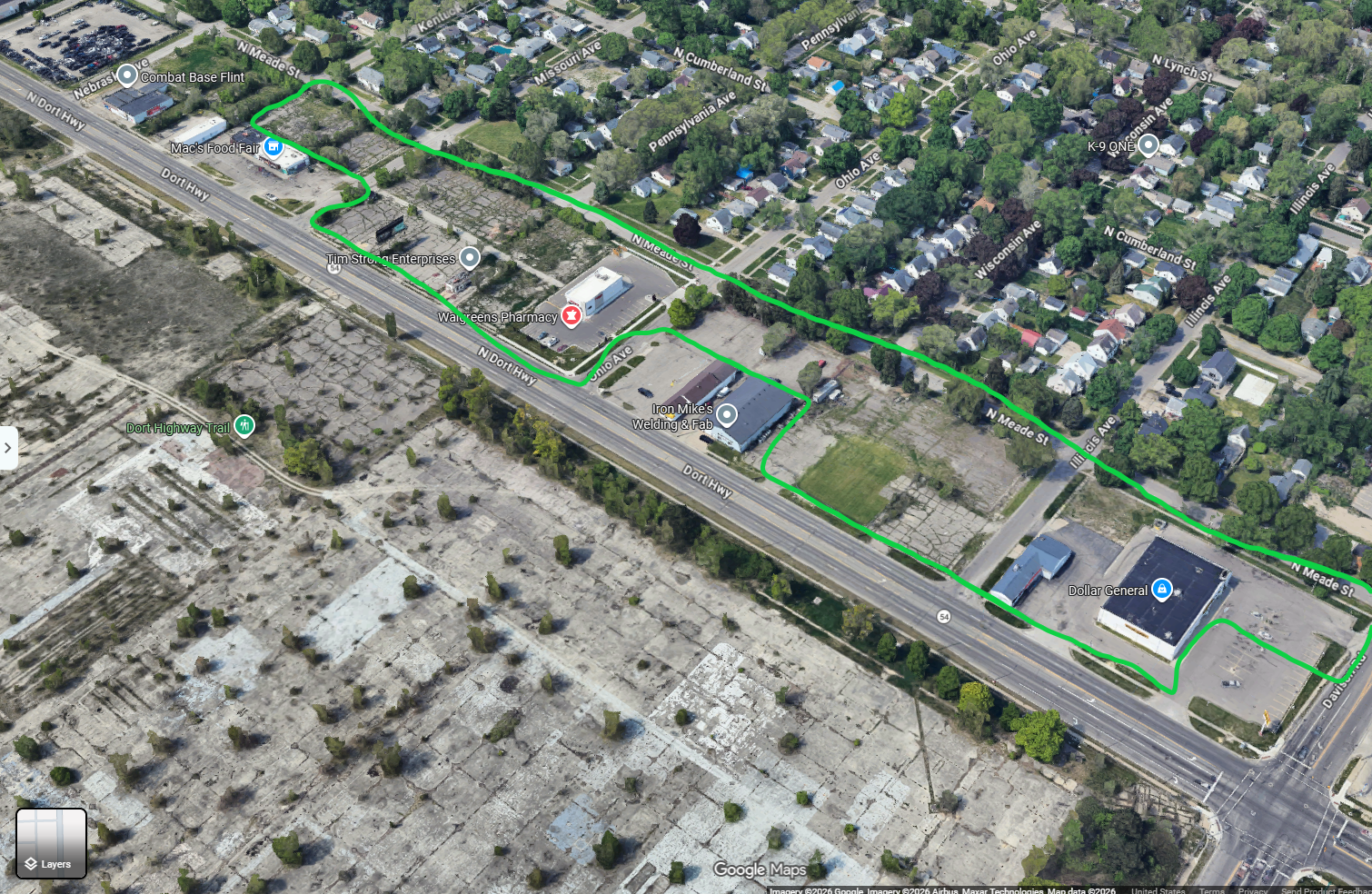
Across Dort Highway, I can still trace the rough outline of the parking lots my mother walked when I was a kid. The booths are gone. Some of that land has been redeveloped. A lot of it hasn't.
In my mind, I could see the whole system that used to exist there: the factory and its workers, the parking lots, Mom's Diet Coke, the tow trucks, Mac's and the corner bar. Her paycheck. MY paycheck. Thousands upon thousands of other paychecks.
One enormous web of human activity that once seemed permanent enough that people built their lives around it.
Now there are trees growing through the cracks. Nature finds a way. People have to, too.
A decision-maker may see a plant, labor expense, and excess capacity. The city sees a shrinking tax base. The local diner sees an empty lunch counter. The school district sees dwindling enrollment.
And a kid sees her mother lose the job that used to keep food on the table.
Those are not separate events. They are ripples from the same stone.
Scientists at Los Alamos National Laboratory figured out how to train honeybees to detect explosives. Using Pavlovian conditioning, researchers taught the bees to associate the odors of explosives including TNT, C4 and TATP with a sugar reward.
Other researchers took the idea further. One portable system, called VASOR, held 36 trained bees at a time while a camera and image-processing system monitored their responses.
Thirty-six living creatures, strapped in their little bee harnesses, functioning as components in a detection apparatus.
And yes, the bees could eventually be returned to the hive. That's almost beside the point.
Bee becomes sensor. Living creature becomes input. All the system needs to know is whether it detected the thing, performed its function, and produced the expected output.
Everything else about being a bee becomes irrelevant to the system.
One day, the bee's minding its business, flying back to the hive from a patrol, when it gets sucked into a vacuum-like collection device, relocated for training, strapped into a tiny little bee-holder, and put to work like a cog in a machine.
I keep wondering how often organizations do the same thing to humans.
Employee becomes headcount. Student becomes enrollment. Customer becomes revenue. Human being becomes productivity.
Useful. Measurable. Replaceable.
Until they're not anymore.
The problem isn't measurement. The problem is confusing the abstraction with the thing itself.
One of the Four Horsemen of Organizational Collapse is what I call Quiet Compliance.
That's what happens when people stop arguing, put their head down and “just do the job.” Go along to get along, as my Dad used to say.
Leadership often mistakes it for alignment, but it isn't always. Sometimes it's just disagreement without enough leverage to matter.
Lately I've been watching this pattern show up all over the news:
Different institutions. Different countries. Different fights.
But I keep seeing the same shape underneath them:
The people downstream from the decision are trying to force themselves back upstream into the decision process.
Maybe they believe you didn't hear them or you didn't account for what this would do to them. Maybe you're asking them to carry risks so you won't have to! Maybe the official process gives them no meaningful leverage. Or maybe the decision has already been made, so ordinary participation feels pointless.
At that point, protest isn't simply “resistance to change.” Protest becomes a governance mechanism.
Sometimes disruption is what participation looks like after ordinary participation has failed. This is where the Consequence Gap becomes something much more dangerous.
When the people living with a decision no longer believe the people making it understand, represent or even adequately consider the lives affected by it, the problem is no longer just disagreement about the decision. It's a question of whether the decision-maker still has legitimacy in their eyes.
This pattern is much older than corporate America.
Remember the French Revolution from history class?
Eighteenth-century France was its own specific political, economic and social system. I'm not suggesting we're heading for another version of the French Revolution here. I'm saying there's a pattern that looks familiar.
France was dealing with severe fiscal problems and economic pressure. Food prices were rising. Political privileges and burdens were distributed unequally. The Third Estate represented the vast majority of the population, but a growing number of them rejected the reigning political structure that they believed failed to represent their interests adequately.
The people with power and the people carrying the consequences of their decisions were getting farther and farther apart. Not sustainable.
If that doesn't feel familiar in the Year of Our Lord 2026, you're just not paying attention. It brings us right back to the problem we're seeing today: Legitimacy.
What happens when enough people stop believing that the system making decisions about their lives has earned the right to make those decisions?
The Consequence Gap eventually becomes a Legitimacy Divide.
And once legitimacy is gone, telling people to comply harder is a failing strategy.
The future isn't inevitable.
I look at the corner of Dort and Davison in Flint and see those trees as a warning. Flint didn't become the way it is today because of one decision by one villain on a Tuesday afternoon!
Management and unions made decisions. Government made decisions. Workers made decisions. Some people had enormous leverage. Some had almost none. Some could leave. Some couldn't. The consequences accumulated anyway. That's how systems work.
One decision creates conditions for the next (and the next), until one day you're looking at satellite imagery of trees growing where thousands of people once earned their living, wondering how something that enormous disappeared.
The same is true in whatever comes next: AI. Automation. Restructuring. Climate adaptation. It's organization (and location) agnostic.
We can't stop making difficult decisions. But we need to remember the life behind the abstraction before the people carrying the consequences have to force us to remember.
What ripples aren't showing up in your analysis? Who is close enough to the consequences to see something you can't? And how much distance stands between authority and consequence?
Because people are not numbers.
Numbers can describe people. They can help us make decisions about systems filled with people.
But the moment we confuse the abstraction with the life it represents, we start creating consequences our spreadsheets cannot calculate. And Quiet Compliance can make that system look stable for a very long time.
Right up until it doesn't.