
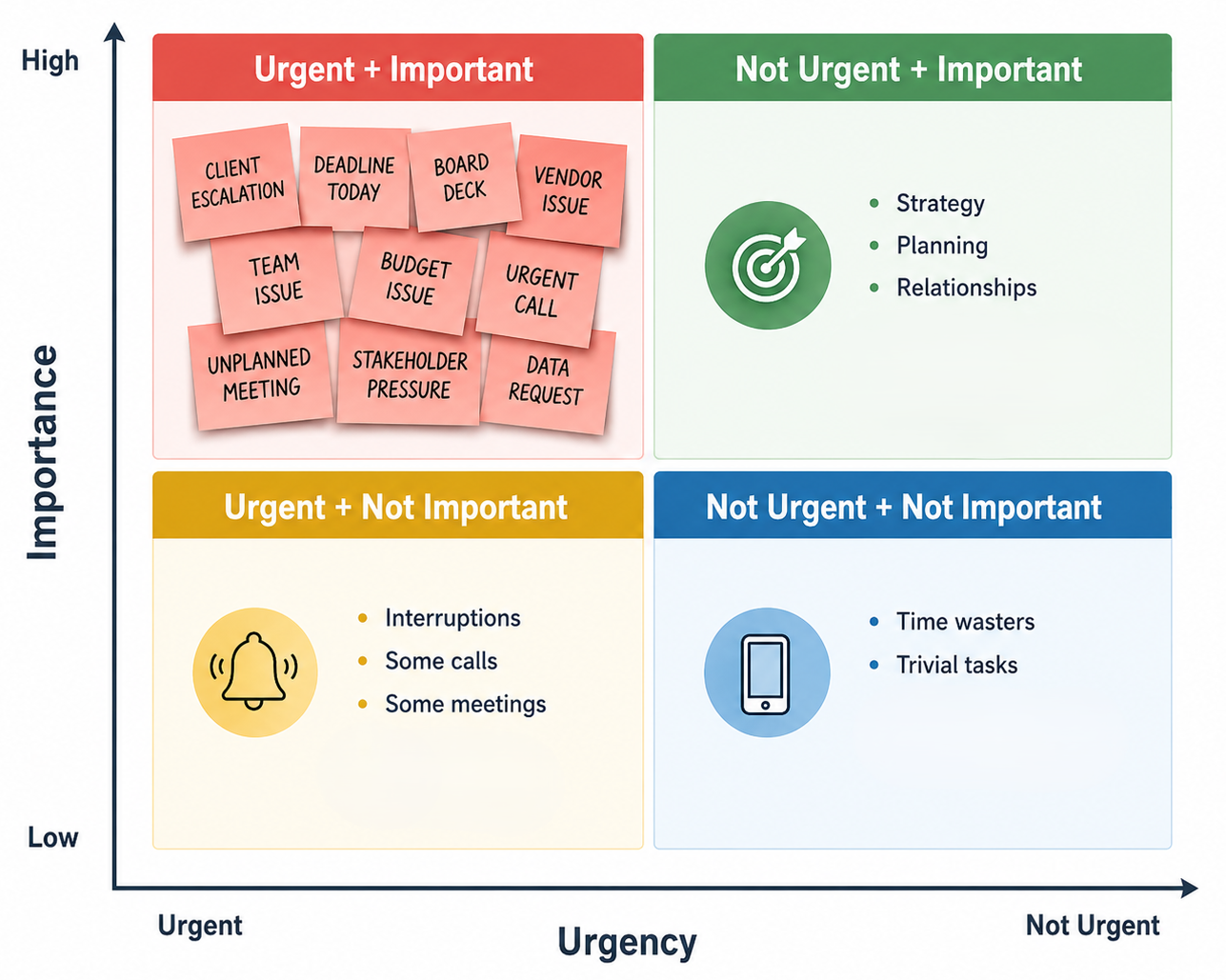
Y’all remember the Eisenhower matrix?
It’s the classic four-quadrant tool that helps you sort tasks by whether they’re urgent, important, both, or neither.
And when the categories are clear, it’s genuinely useful.
Urgent and important? Do it.
Important but not urgent? Schedule it.
Urgent but not important? Delegate it.
Not urgent and not important? Delete it.
I've used it for years and helped my clients apply it in their own life and work.
It works great...until it doesn't.
I mean, what happens when you’re in a season where E'RYTHANG looks like it belongs in the “urgent and important” quadrant?
That’s the part most prioritization advice skips.
And it’s the part a lot of leaders are living inside right now.
I talked about this on LinkedIn the other day: Urgency is not the same as priority. That post came from watching the way current leadership conversations are being framed at the highest levels.
Reuters reported that AI executives from Anthropic, OpenAI, Google, and Mistral are expected at the G7 summit as leaders discuss AI and online safety. Another Reuters report described the G7 agenda as dominated by Iran, Ukraine, global imbalances, critical minerals, and crisis management, with no major breakthrough decisions expected. Reuters NEXT Europe is also being framed around defense, energy, AI, industrial renewal, regulation, and business leadership under pressure. [1][2][3]
That means right now, leaders are trying to navigate AI, regulation, market pressure, geopolitical instability, talent issues, public trust, economic uncertainty, energy concerns, and strategic transformation… all at the same time.
That’s a lot!
And it’s not just happening on the world stage.
It’s happening inside organizations, leadership teams, founder-led businesses, and boardrooms everywhere.
The issues may be smaller in scale, but the pattern is the same:
Everything's trying to compete in the "Urgent & important" quadrant of the good ol' Eisenhower matrix.
And everything can’t be first.
You can't have a ten-way tie for first place.
Everything can be important.
Everything can deserve attention.
Everything can carry consequences.
But everything cannot be the number one priority.
The moment leaders start treating every issue as Priority One, priorities stop being priorities. They become a list of things people feel guilty about not doing fast enough.
Even in organizations with multiple departments, each area can only have one true priority at a given moment.
Sales may have a top priority that's different than Operations. And that may be different from HR or Finance.
But within each function, there is still a decision being made about what comes first.
It's a statement of sequence.
It's the answer to the question:
"What has to happen before the next thing can happen?"
That's why prioritization gets so uncomfortable.
Choosing a priority doesn't mean the other issues stop mattering.
It means you're deciding what gets protected first, funded first, staffed first, discussed first, and solved first.
And every time you make that choice, you're implicitly deciding what will wait.
That's the part many leaders try to avoid.
But avoiding the choice doesn't eliminate the tradeoff; it just hides it.
You'll eventually feel those consequences anyway.
So when everything looks urgent and important, the challenge isn't figuring out matters most (because it's ALL important!)
The challenge is deciding which one truly comes first.
Because everything can't be first.
When everything feels urgent, the natural impulse is to move toward the loudest problem:
And sometimes, yeah, the loudest problem needs immediate attention.
But not always.
Sometimes the loudest problem is just where the pressure valve is whistling.
The real issue may more likely be a decision nobody wants to make, a tradeoff nobody wants to own, or an initiative that you need to stop pretending is still on the table.
That’s decision friction.
What has to be decided first so the rest of the work can move?
That question changes the room.
Because now you’re looking for the decision underneath the noise.
This is where leaders can get themselves into trouble before things become a full-blown crisis.
Pre-crisis rarely looks dramatic.
It doesn’t always look like collapse.
It often looks responsible.
But when everything stays on the table, nothing has really been decided.
A packed agenda, like the one planned for the G7, can tell you what matters.
But a clear decision tells you what moves.
That’s a very different thing.
When leaders don’t name the real decision, the organization starts paying for it in ways that don't look like a big deal at first, but they compound over time:
And everyone is tired because they’re working hard, but they’re still carrying too many unresolved decisions.
That indecision is expensive.
It costs time, money, market position, talent, and credibility.
When I talk about decision clarity, I’m not talking about having perfect certainty.
We live in reality, not a dream world. Things move too fast for that (sorry Linears!).
High-stakes decisions rarely come with perfect certainty.
Decision clarity is about knowing what decision you’re actually making, why it matters now, what tradeoff comes with it, and what order the work needs to happen in so the system can move without breaking.
That last part matters.
Order of operations is not just a math thing (Thank God! My degree's in Music!).
It’s a leadership thing.
Some decisions need to happen before other decisions can make sense.
Some projects need to stop before the team has room to execute the new priority.
Some ownership gaps need to be closed before the work can move without becoming another fire drill.
The move that matters is not always the biggest, sexiest move.
It’s not always the one people are yelling about.
It’s the move that makes the next right thing possible.
When everything feels urgent and important, don’t start by asking which task belongs in which quadrant.
Start with any of these questions:
That’s where clarity starts.
Not with a prettier list.
Not with another prioritization hack.
With the courage to name the real decision, sequence the work, and give people enough clarity to move without leaving the entire organization wondering what's going on.