
Before doctors knew there were blood types, they were already pumping blood into people.
And it wasn't always human blood.
Seriously.
In the 1600s, some folks believed blood carried more than oxygen and nutrients: it carried vitality, temperament - maybe even something essential about who you were. They didn't know back then that DNA was a thing... they were SO CLOSE on that bet!
But I digress...
Back to temperament. When a patient was agitated or "mentally ill", some doctors would transfuse blood from a "calmer" animal.... like a lamb or a cow.
Yes. Really.
French physician Jean-Baptiste Denys "successfully" transfused calf’s blood into a man with psychosis. The thinking was that the animal's blood might "purify" the patient’s own blood and make him right as rain again.
Dr. Denys was subsequently tried for murder.
People died. Countries banned the procedure. For more than a century, nobody was doing transfusions in Europe (at least, not legally!)
Then, in the 1800s, British obstetrician James Blundell saw women bleeding to death after childbirth and revisited the idea of transfusions. This time, with the notion that maybe it would work if we just stick to our own species. She lost human blood, so maybe replacing it with human blood could save her.
But it didn't always work. Sometimes the blood clotted and the mother still died.
Then, in the twentieth century, scientist Karl Landsteiner mixed red blood cells and serum from members of his research staff to see what would happen. Some combinations sat there doing nothing. Others clumped together.
He could have called the clumping an experimental glitch. A "blip" on the radar.
Instead, he mapped it.
The “blip” followed a pattern. Human blood was not interchangeable. Landsteiner identified three blood groups (now called A, B, and O) and a fourth (AB) was identified soon afterward. That discovery helped explain why one transfusion could save a life while another could kill the patient.
The model they thought they were working with (human blood is interchangeable), was generating enough anomalies that something wasn't right, but rather than scrap the project, doctors plowed ahead anyway because of the lives that they were managing to save.
But their understanding of the problem was incomplete. Landsteiner took the time to figure out why.
This happens inside businesses all the time.
We find something we think will work, build a model, and then scale it up!
Then, something doesn't behave the way the model says it should.
A delay, an overrun.
An outlier. Something that keeps the math from "mathing".
And because everything else appears to be working, we call it "a blip" on the radar.
But a blip is proof that something in the data (or our understanding of it) is incomplete.
That incompleteness gets harder to see as the numbers get bigger.
A $10,000 mistake inside a $100,000 project is an emergency. Somebody's head is gonna roll!
The same $10,000 inside a $100M forecast looks like a rounding error...
...until it happens 500 times!
A forecast can scale the opportunity without scaling your organization’s ability to absorb errors.
Real estate is particularly good at hypnotizing us with big numbers.
Houses are expensive. Even a small margin on each transaction can add up quickly when you multiply it across thousands of homes like Zillow did.

On paper, Zillow Offers sounded seductively straightforward:
Zillow certainly had every reason to believe it could pull this off. It had the brand recognition, access to capital, and sophisticated models for estimating property values.
But there was a bigger question that wasn't considered: Can the entire system buy, repair, carry, list, and resell thousands of individual houses fast enough for the math to keep mathing?
In Q3 2021, Zillow announced the wind-down of the Offers program. Zillow sold about a third of the homes it bought that quarter. They finished the quarter with 9,790 homes in inventory and another 8,172 under contract to purchase. The company said the unexpectedly high number of purchases was putting additional pressure on its renovation and resale capacity.
That word... unexpected... caught my attention.
I don't know about you, but when I'm buying a home, I've got a clear understanding of just how many homes is too many to buy. Granted, I'm not buying dozens at one time, but it seems almost TOO logical that you'd put a cap on purchase inventory. Why was the number of purchases "unexpected"?
I can't tell you the number of real estate agents who've told me over the years that Zillow's "zestimate" is way off. Perhaps there's something there? According to Zillow's annual report, more homeowners were accepting its offers because Zillow was unintentionally offering more for the houses than it could reasonably expect to recover when it sold them.
That "unintentionally" is doing a lot of heavy lifting. Plenty of buyers overpay to get a home they really want. Generally, the only way you unintentionally over-pay for a home is if you're not paying attention.
And Zillow was doing it at scale.
Zillow's pricing model caused them to win far more deals than expected. By the time they realized that winning those deals was part of the problem, it was too late.
When you're dealing with large numbers, like Zillow was, you can fool yourself into thinking that the "blip" is improved conversion: more sellers saying "yes".
I guess nobody thought to check the math. Because inside their system, overpriced inventory was entering the pipeline faster than Zillow could renovate and resell it.
Capacity matters.
At first, a delayed renovation is no big deal:
Just a blip. Look at how many homes are moving exactly as planned!
But that house is also locked-up capital. Holding costs that continue to accumulate while the market keeps moving.
Multiply that across thousands of homes and “no big deal” becomes a bottleneck that chokes profitability.
One delayed project might be manageable. Thousands of delayed projects create trapped capital and compounding exposure.
By the end, Zillow had recorded a $304M inventory write-down because they purchased homes for more than they could sell them for. They also expected another $240-$265M in losses, primarily on homes it was already committed to buy.
That's upwards of a half a billion dollars, all in - which doesn't feel like a blip to me.
But the problem didn't begin with a $304 million loss.
It began with inventory entering the system faster than the system could move it back out.
Each blip was small enough to explain away, but added together, they were telling Zillow that one of the central assumptions for their model was incomplete. Their Conditions for Success were out of alignment!
That is the danger of scale: big numbers distort our judgment in both directions.
The upside looks so enormous that it feels inevitable. The early downside looks so small by comparison that it feels immaterial.
“Immaterial” may be a useful accounting designation, but it's not a sound strategic diagnosis.
A million-dollar problem can look inconsequential inside a billion-dollar opportunity, until you realize it's not a million-dollar problem...
...it's a repeating condition built into the system.
Scale gives small errors more places to hide.
And by the time the blip is large enough to command everyone’s attention, you're no longer investigating an anomaly. You're trying to dodge a torpedo!
Zillow had guardrails: financing limits, lending restrictions, property eligibility requirements.
What they apparently did not have - at least not strong enough to stop the machine - was a hard stop tied to acquisitions.
That's where forecasts become dangerous.
A model can tell you what a house is likely to be worth in three to six months. It can estimate the cost of repairs or calculate a projected margin.
But the real business decision was a bigger, more complicated question:
Can we buy this house, complete the work, sell it within the necessary window, and still make the numbers work if something takes longer, costs more, or moves differently than we expected?
And then, at Zillow’s scale:
Can we do that thousands of times at once without the entire pipeline backing up?
The model could calculate the opportunity, but it couldn't tell Zillow whether their system had the capacity to carry it.
Having enough money to buy a house is not the same as having enough capacity to do everything required and sell it for a profit before the assumptions driving the model change.
That's the capacity issue: not just how much "activity" the system can perform, but how much delay, variation, and error the system can absorb before everything collapses like a house of cards.
To be fair, AI and predictive models can incorporate operational variables, but only if someone knows those variables matter and feeds them into the machine.
AI can optimize any decision you give it. It cannot guarantee that you gave it the right decision.
If you ask what price a house will sell for in six months, AI will generate a persuasive picture of what is likely to happen next.
But it won't tell you if that's the wrong question to ask in the first place.
Maybe the better question was, "What has to remain true across the scope of this project in order to produce the return we expect?"
That's an entirely different question!
One predicts an outcome, while the other examines the conditions required for success.
What's missing from your data? Which assumption has never been meaningfully tested? When does a "minor exception" become a pattern worth investigating?
And the big one that any company can ask: What part of the system has no margin for error?
The danger starts when leaders mistake yesterday’s evidence for foresight about tomorrow. As I learned in my time as a financial advisor: past performance is not indicative of future results.
That's why the blips matter.
A delayed renovation may just be a delayed renovation, or it may reveal that contractor availability is harder to come by than your model assumed.
More buyers may be proof that customers love the offer, or it may mean your pricing is off.
The blip, by itself, doesn't prove the strategy is wrong; it proves the model is incomplete.
That should make us curious.
Instead, big forecasts often make leaders more certain.
The numbers are huge, the opportunity is thrilling, the math checks out, and the stakeholders are pleased.
So, if/when contradictory evidence arrives, the organization doesn't always ask what the blip means.
Sometimes it says, "Just ignore that blip. Look at everything else that’s working!"
And that, my friend, is how a blip becomes a torpedo!
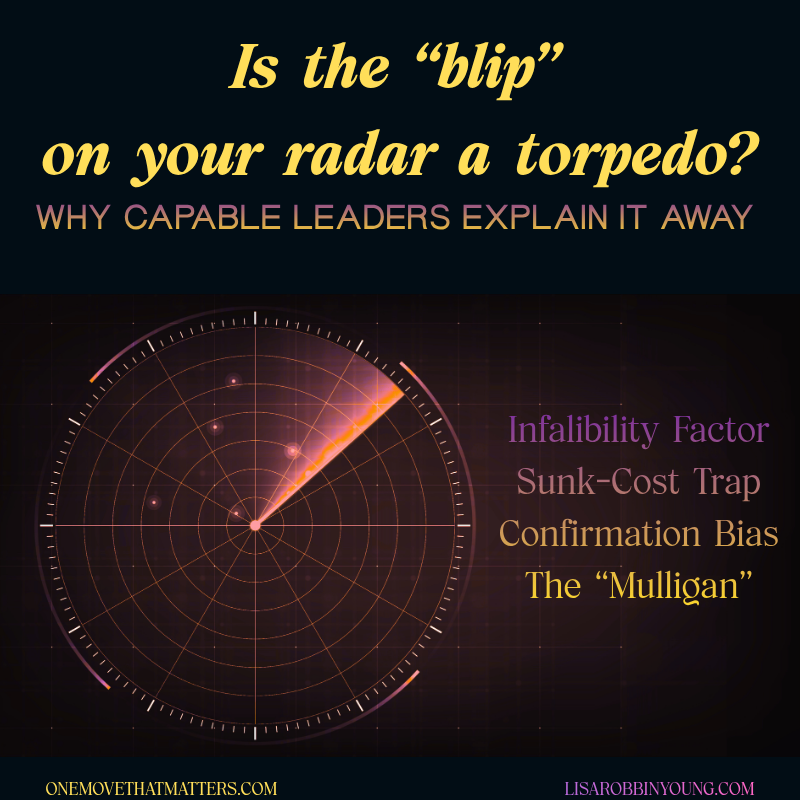
Now, the folks ignoring the blip are probably not asleep at the wheel. They're smart, experienced leaders with good intentions, credible data, and a lot riding on the decision.
That can make the problem worse, because capable people are great at explaining why contradictory evidence doesn't mean what it appears to mean.
They don't always miss the warning. Sometimes, they just need it not to matter.
There are (at least) four things at play here:
"We can’t possibly be wrong about the whole thing because one part of it is behaving strangely.
Right? Right?"
When a model looks sophisticated (or persuasive) enough, leaders can treat it like reality rather than what it actually is: a collection of assumptions about reality.
The math may not lie, but it can answer the wrong question with astounding accuracy.
It can also be fed incomplete data, stale assumptions, or variables that were weighted incorrectly because nobody really knew how much they would matter.
The blip threatens more than the forecast. It threatens the organization’s belief that it understood the problem.
So the anomaly becomes “normal variance.” A temporary disruption. A one-off. No big deal.
And the temptation is to misdirect onlookers from the blip and celebrate what is working instead.
"We've already invested so much into this direction. We can't change now!"
The capital. The contracts. The executive credibility. The investor promises.
The months (or years) spent telling everyone this was the future.
Once an organization has committed enough resources to a strategy, reconsidering it can feel more expensive than continuing.
Stopping means admitting that the investment may never produce the expected return. Continuing gives everyone (false) hope that the original decision will eventually be vindicated.
"See? It's (mostly) working!"
Some customers convert. Some markets perform exactly as predicted. Revenue grows.
That success becomes "proof" that the strategy works.
Meanwhile, the contradictory evidence is treated as an exception that will resolve itself later.
This is especially dangerous at scale because the parts of the model that work can be genuinely impressive!
Zillow was buying thousands of houses, which looked like momentum.
But the fact that one part of the machine was accelerating did not mean the whole system was healthy.
The same number can support two very different stories.
Leaders tend to favor the one that confirms the decision they already made.
"We've got a deadline to hit or we lose our investors!"
The board wants progress. Investors want growth. The CEO has already talked about it publicly.
Nobody wants to go back to the drawing board.
That feels like failure.
So they keep pushing to "ship" on time, ignoring the warning signs that should be making them curious.
"The forecast can't be wrong. We've invested too much to stop. The parts that are working prove we should continue! Besides, we can't afford to return without a result."
By the time the anomaly is impossible to ignore, the organization has spent months building an increasingly sophisticated explanation for why it was safe to ignore it.
They saw the blip, but they needed it to not matter.
Strong leaders have conviction. They believe in the vision. They hold the line. They keep going when other people lose their nerve. That's why they're the leader!
AND... sometimes conviction is what drives the ship straight into the torpedo.
Conviction to "full speed ahead" and "growth at any cost" can turn contrary evidence into an inconvenience.
Growth at any cost doesn't leave much room for the curiosity needed to consider the blip.
Landsteiner didn't scrap transfusions because of blood clumping.
He also didn't charge full speed ahead because some blood samples looked fine.
He investigated what didn't fit because he was more committed to understanding the system than defending the existing model.
That is what helpful conviction looks like.
It may mean putting your best people on the anomaly, or slowing (or even stopping) forward motion entirely while you figure out what is happening. It may mean building a contingency before you need it.
And yes, sometimes the blip will turn out to be a nothingburger.
But you still did the responsible thing with the evidence available to you.
The goal here is to avoid becoming so committed to the outcome you want that you stop being curious about all the evidence you have.
Leaders are not perfect.
AI isn't perfect either. It has biases because it's built from human inputs, human assumptions, incomplete data, and human decisions about which outcomes deserve attention.
AI can identify the anomaly, but it cannot guarantee that we asked the right question.
When inventory began backing up at Zillow, the delays weren't just blips. They were evidence that purchasing too fast could bottleneck the system responsible for turning those houses back into cash.
It seems nobody asked that question... not even AI.
The visible problem may be small, but what it reveals about the model isn't.
That is what AI can't resolve for us on its own.
It can't decide what level of uncertainty we're willing to carry. And it can't determine whether we're more committed to defending the forecast or understanding the evidence that contradicts it.
That part still belongs to us.
When the numbers are big, the opportunity looks impressive, and one inconvenient detail refuses to fit, ask yourself:
If this blip later appeared on the evening news as the smoking gun, are we confident we did everything we reasonably could with what we knew, the resources we had, and the potential harm involved??
Maybe you investigate and discover it's just a blip.
Not every blip is a torpedo, but we need to be honest enough to recognize when the evidence is challenging the story we want to believe.
Because when you are building something that matters, the blips matter too.
And you don't find out which one you are looking at by pretending it's nothing.
This is not a demand for perfection. People will still misread signals. Organizations will investigate something that turns out to be harmless and dismiss something that later proves important.
The standard is not omniscience. It is responsible attention. Something AI still can't do by itself.
If you are staring at a blip and cannot tell whether it is ordinary noise, an emerging bottleneck, or evidence that the underlying decision needs another look, bring me the decision you are circling.
Sometimes the One Move That Matters® is not pushing forward or pulling the plug.
It is getting clear about what the evidence is actually asking you to reconsider.