As I started writing this, I was just days away from hosting the final Creative Freedom Retreat. It's the bow on a 10+ year run serving creative entrepreneurs and the lives and businesses they're creating for themselves. Next year's retreat will be different in a lot of ways, but the core question will still be the same:
What really matters to you, and who are you becoming in pursuit of that?
For a long time, I wanted to be the voice for creatives. Not because I really wanted to be, but because I believed I HAD to be if I was ever going to break through in the market. So I built a business around that identity.
I wrote a book. Hosted podcasts. Appeared in other people's books. Created courses, programs, and resources to help creative entrepreneurs build profitable, sustainable business.
Most importantly, I launched the Creative Freedom Incubator, a pay-for-results program designed to offer business coaching AND hands-on support inside my clients' businesses.
The final participant graduates this month. Just in time for the launch of what's next for me.
And what's next? An entire overhaul of my business model.
Somewhere along the way, I invested so much of myself in helping my clients build the businesses and lives THEY wanted that I lost sight of what I really wanted for myself.
I'd developed an identity, a brand, and a business model around being a coach and consultant. While I'm pretty good at coaching and consulting, I'm hella good in front of an audience.
I was built for the stage. And I don't even care what kind of stage!
Theater. Film. Television. Boardrooms. Broadcast radio. Podcasts. National conferences. Teleclasses (remember those? Long before Zoom, we had teleclasses). Put me in front of an audience and I come alive! And so does the audience. I've been that way since I was a preschooler, wrangling up the neighbor kids and charging them a nickel to watch me sing and dance.
And still, somehow, I found myself neck-deep in helping clients instead of doing what I'd most wanted to do since I was little. Don't get me wrong. I love my clients. I loved doing client work. But as I've told my clients for decades: Just because you're good at something doesn't mean you should be doing it.
Apparently, it's time to take my own advice.
Instead of coach-author-speaker, I'm stepping into my speaker era. Speaker. Author. Decision-making strategist. In that order. And that's not just semantics. It's a complete rebrand and a fundamental shift in my business model, with all the collateral investment that goes along with it.
It's also a risk.
Some of my longtime clients won't need what I'm offering next. Some of the relationships and revenue streams I've spent years developing won't carry forward into this new version of the business.
I'm making a deliberate choice about what kind of business I want to build next and walking away from what I spent more than a decade building. A business built around what I was good at. Now I'm building a business around what I was born to do.
It's forced me to confront a question that turns out to be relevant for some much bigger companies, too.
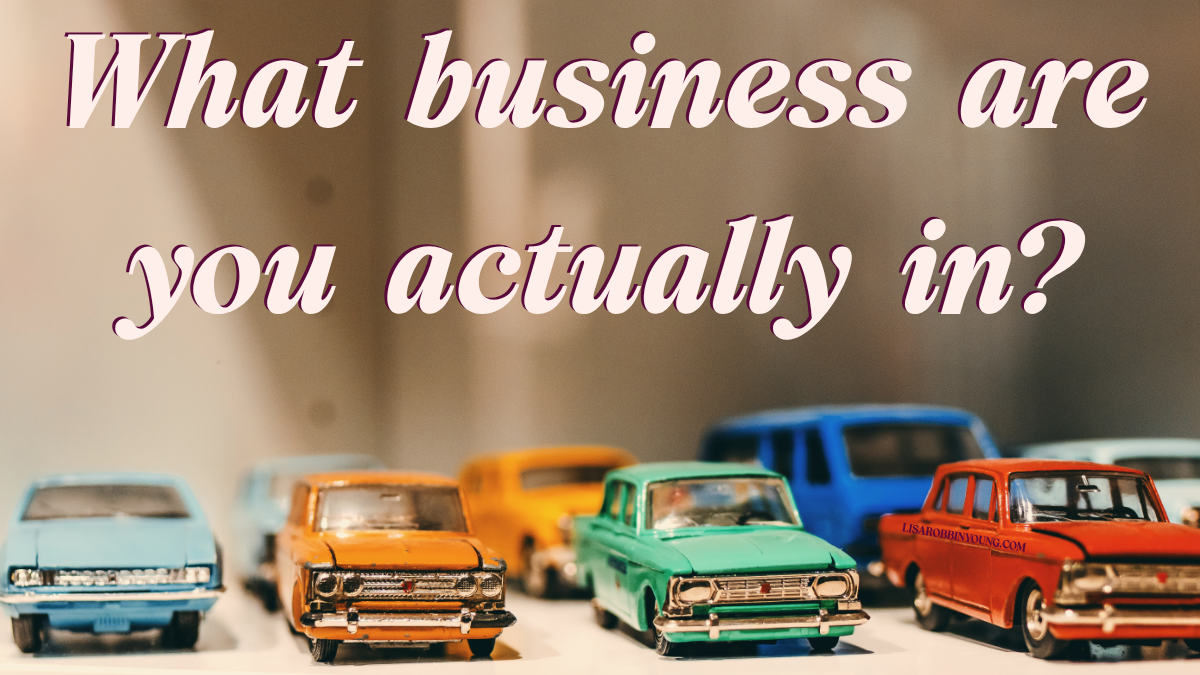
There's a difference between the business you built, the business you want to build, and the business you're actually becoming. Sometimes those three things align, and sometimes they don't.
And sometimes you don't realize how far apart they've gotten until a consequential decision forces you to look.
That consequence happened for me last year, but watching a movie with Jim last night helped me see it playing out elsewhere.
Jim and I watched Matchbox: The Movie, the new John Cena action flick on Apple TV. We'd seen Barbie when it came out and didn't particularly like it. I caught some crap from friends about that one, but that's another story for another day.
Matchbox, though? We both enjoyed it. It was pure brain candy. A fun action movie that didn't require us to think too hard. But afterward, I found myself thinking about something else.
When I was a kid, Mattel made awesome toys. Barbie. Hot Wheels. All kinds of stuff that fueled the imagination. Matchbox wasn't even one of Mattel's brands back then! In fact, Matchbox and Hot Wheels were COMPETITORS. Matchbox eventually came under Tyco's ownership, and Mattel acquired Tyco in 1997, bringing the two brands under the same corporate umbrella.
So here we are, nearly 30 years later, watching a movie built around a brand Mattel didn't even create. I started wondering: Is Mattel really in the toy business anymore? Or is it becoming a purveyor of nostalgia?
Barbie wasn't just a movie for little girls who play with dolls. Adults who hadn't touched a Barbie in decades showed up wearing pink, buying merchandise, and participating in the cultural phenomenon. And Matchbox isn't really about toy cars. It's an action movie built around a brand many of us remember from childhood.
Nobody had to buy another Matchbox car for us to enjoy the movie.
But our familiarity with the brand was already there. In fact, many people call all tiny cars, “Matchbox cars” no matter what brand they really are! Mattel didn't have to create that connection from scratch. It had decades of brand recognition to work with.
Mattel spent decades making products that created memories. Now it's exploring how to make products out of those memories.
What exactly is for sale at Mattel?
Mattel’s 2026 shareholder report described their new strategy:
...to grow our intellectual property (“IP”) driven play and family entertainment business, bringing together two important and fundamental concepts. The first is the continued expansion beyond physical product, with content, licensing, and digital games as key high-margin growth drivers. The second is an increased orientation around brand management, which will allow us to capture the full value of our IP across both toys and entertainment.
Essentially, Mattel wants to generate value from its brands through more than physical toys, but they don’t yet plan to get out of the toy business. Physical toys are still part of what gives those brands continuing relevance.
But toys are no longer the only way Mattel expects to make money from Barbie, Hot Wheels, Matchbox, and the rest of its portfolio.
In September, Mattel announced that Roger Lynch would succeed Ynon Kreiz as CEO.
Lynch was a board member and independent Lead Director before assuming this role. He’s led Condé Nast, Pandora, and Sling TV, so he understands media.
Kreiz is now the co-CEO of Paramount Skydance… the same production company that Mattel partnered with for the Matchbox movie.
Coincidence? I think not.
Taken together, these developments show us that Mattel is serious about continuing to think beyond being a toy manufacturer. And investors are asking whether Mattel is even the right organization to own all that value.
Before Kreiz stepped down, Southeastern Asset Management urged Mattel to consider strategic alternatives, including going private or selling the company. In October, Ariel Investments joined the pressure. Then came reports that Authentic Brands Group had expressed interest in acquiring Mattel for roughly $6 billion.
That’s not chump change.
Authentic Brands is built around acquiring, managing, and licensing well-known brands. They don’t make toys, which begs the question: what would Authentic Brands actually be buying?
A brand-management company, a film studio, and a toy manufacturer could look at Mattel's portfolio and see three very different futures for the company.
Which raises bigger questions: At what point does Mattel stop being a toy manufacturer that makes movies and become an intellectual-property business that also makes toys? And who gets to make that decision?
This is about more than marketing. It’s a decision about what assets to invest in, which capabilities to build, what kind of leadership the company needs, and how the value it creates will be captured.
It reminded me of Apple’s big computer give-away in the early 80’s.
Apple was selling computers. But it was also creating customers. In 1983, Apple launched a program called Kids Can't Wait, offering free Apple IIe computer systems to thousands of eligible California schools. Apple was already a major supplier to schools, and the program had an educational purpose. Students needed access to computers. But there was also a business opportunity.
Get computers into classrooms. Help teachers learn how to use (and eventually to sell) them. Encourage software developers to create programs for them. And give an entire generation experience with Apple technology.
Apple wasn't only competing for the computer purchases schools were making that year. It was helping shape the market for years to come. When those kids grew up and started buying computers for themselves, the hope was that Apple would become the computer of choice because it was the frictionless option.
The sales ecosystem expanded into higher education through the Apple University Consortium, putting more Apple computers on college campuses. And for a while, Apple's educational advantage was enormous.
The Apple strategy worked. Until the world changed around it.
By the mid-1990s, Windows-based PCs were more common in workplaces and homes. Parents were using Windows at work and buying Windows machines for their families. At the same time, Apple was struggling financially and restructuring its operations. Schools were reconsidering which technology to put in their classrooms.
That created a problem.
Building the conditions for demand isn't the same as permanently controlling them.
Even if an organization's immediate restructuring decisions make financial sense, those decisions can affect the confidence of people who have invested in its long-term success. Schools weren't merely buying computers. They were choosing a technology platform, training teachers, adopting software, and planning for the future.
Apple's financial stability mattered because those decisions depended on Apple continuing to be there. The company had invested in creating an ecosystem. But when market conditions changed and confidence weakened, that ecosystem couldn't guarantee customer loyalty.
And that brings us to Nvidia.
On September 28, Nvidia announced an additional $150 billion in authorized stock buybacks, bringing remaining authorized repurchases to approximately $235 billion. A stock buyback happens for a number of reasons: to give money back to shareholders, reduce the number of outstanding shares, or signal confidence in the company's value, among other things.
But Nvidia is also doing something else with their money. They’re funding companies in the AI race to help those partners develop the systems that will use Nvidia technology. They even acknowledged that some people might consider this “circular financing” on some level. Nvidia argued that its investments support a major technological transition, generate business, and offer attractive investment returns.
I get it… a chip company makes money when customers buy chips. But if your customers need billions of dollars in infrastructure before they can buy and use your chips at the scale you're forecasting? Should you also invest in those customers, help finance their infrastructure, and support the larger technological ecosystem?
Nvidia thinks so. Instead of waiting for demand to appear, they’re helping create the conditions for that demand, similar to what Apple did in the 80’s. But what happens if/when the ecosystem becomes dependent on those investments?
If customers are buying Nvidia products partly because Nvidia helped finance their expansion, how much of that demand would exist without continued financial support? If market conditions change or investment slows, who absorbs the consequences? And when one company is simultaneously a supplier, investor, infrastructure partner, and beneficiary of the resulting demand, how do its leaders evaluate the risks?
Nothing here proves that Nvidia's demand is artificial or that its investments are inappropriate, but Nvidia's decisions need to be seen on a landscape bigger than just semiconductor sales. The company is making commitments that likely influence the development of an entire market... commitments that carry risks beyond how well any particular chip might sell.
So, what business is Nvidia REALLY in?
The business you built isn't necessarily the business you're becoming. All of us have to decide what we're building. Those decisions aren't made solely through declarations about mission, vision, or identity.
They're made through what we will and will not do. Think: investments and partnerships, the customers we choose to serve. The capabilities and capacities we develop and the ones we don’t. Through the people we hire, the work we accept, and the opportunities we pursue (or don’t).
Mattel spent decades making products that created memories. Now, it's exploring how to make products out of those memories. Apple invested in creating future customers for its technology, then had to contend with a changing market that threatened the very advantage it had helped create. Nvidia is making decisions that could shape the infrastructure and demand for the technology it sells.
And I spent more than a decade building a business around work I was good at, only to recognize that I wanted the next chapter to look very different.
Those decisions are more than a rebrand or numbers in a spreadsheet. They hit at the core identity of a business. They change how the business works and affect the people who depend on it.
My old business doesn't just vanish because I've decided to build a new one. Choosing to pursue what I really want doesn't make the consequences of that decision disappear. There are clients, relationships, revenue streams, commitments, systems, and expectations attached to it. Some of those things can come with me. Some can't.
The same is true for any organization, regardless of size. There's the future leadership wants to create, and then there’s the organization that currently exists, with real people and commitments attached.
A sound strategic direction doesn't automatically make every decision required to pursue it a sound decision.
Sequencing matters. The capacity matters. The people who will carry the consequences matter.
The most obvious decision isn't always the decision that needs to happen first. The visible decision might be whether or not to sell a company, but the load-bearing decision may be something else entirely.
What kind of organization are you trying to become? What needs to remain true to get there? If you decide to become something different, you need to determine what that future requires. What are you willing to stop doing so the business you want to build has a real chance of succeeding?
These are not always easy questions to answer.
I know. I'm living it.
There's a lot of history wrapped up in the Creative Freedom Retreat. More than a decade of helping creative entrepreneurs explore who they are, what really matters, and how to build businesses and lives that reflect those answers.
I'm proud of that work AND I'm ready for what's next.
The question at the heart of the retreat isn't going away. If anything, I'm asking it of myself more seriously than ever. What really matters to me, and who am I becoming in pursuit of that? For me, the answer means building a business where speaking comes first.
For Mattel, Nvidia, Apple, and every other organization navigating a changing market, your answers will vary, but the importance of the decision remains.
You can keep making choices that preserve the business you've been. You can allow your decisions to carry you toward a future you haven't fully examined. Or you can look carefully at what you're building and decide whether it's the future you actually want.
Every major decision commits some part of your organization's future.
The question is whether or not those commitments are creating the company you actually intend to build.
And whether or not you're prepared to do what is required to build the future you’re envisioning.